Integration of International Response to National Structures
Intervention teams can be requested from abroad if the operational situation requires more resources than are nationally available.
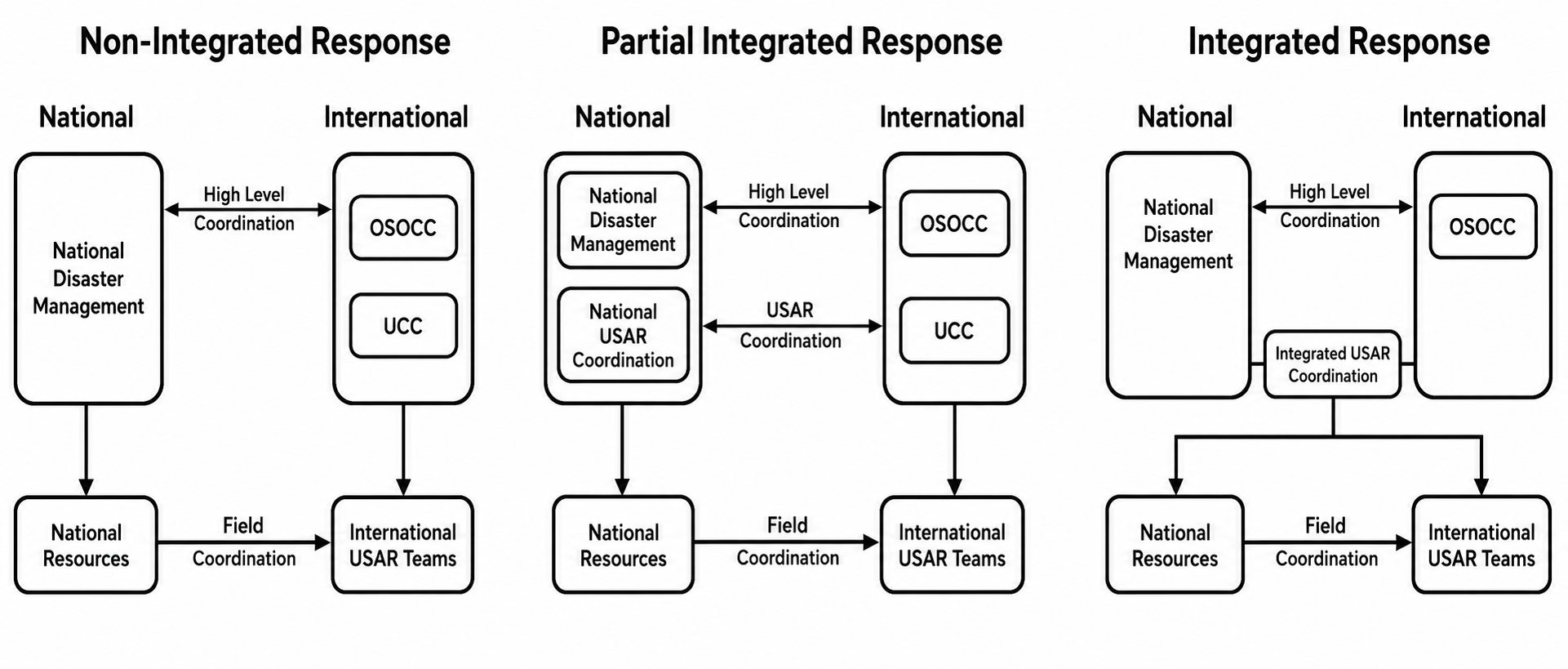
Each country's legal framework typically incorporates a national command and control centre within the LEMA structure, often referred to as an Emergency Operations Centre (EOC). An EOC operates around the clock as the central command and control facility responsible for implementing the principles of emergency preparedness, functioning at a strategic level during emergencies, ensuring operational continuity in affected areas, coordinating interagency needs and resources, and overseeing recovery phases. The EOC provides a strategic overview of disasters, or the "big picture." It generally does not directly control field assets; instead, it makes operational decisions and delegates tactical decisions to subordinate commands. The standard functions of all EOC include collecting, gathering, and analysing data; making decisions that safeguard life and property; maintaining continuity within the country in accordance with applicable laws; and communicating those decisions to all relevant agencies and individuals. In most EOC's, the LEMA Emergency Manager supervises the facility.
In the non-integrated model, the incoming international USAR units establish their coordination unit, as there is no national-level coordination unit specifically focused on USAR activities. Coordination occurs at a high level between the EOC and the international coordination unit. The individual teams collaborate with the national operational teams at a lower level. In the partially integrated model, there is a coordination office in the EOC at the national level. This results in high-level coordination between the overall integration of international aid and the EOC and between international USAR and national USAR coordination within the EOC. The EOC coordinates the national units, while the international USAR teams are coordinated by the international coordination cell. The various teams coordinate directly in the operational area.
In the fully integrated model, the INSARAG approach has been thoroughly implemented in the national USAR strategy. At the highest level, coordination takes place between the EOC and international aid. Together, they coordinate the national and international USAR units. By completely implementing the INSARAG methodologies, international forces can be quickly and seamlessly integrated into the rescue operations.