National USAR Framework
The INSARAG network is strongly encouraged to assist disaster-prone countries in developing the capacity of their national USAR teams. In this context, the term “national USAR team" refers to a USAR team utilised at the national level but not designed for international deployment. This can be either a governmental team or a non-governmental team. INSARAG has drawn on the experience gained both from the INSARAG External Classification (IEC) process and from existing capacity-building programmes of its members, including National Accreditation Processes (NAP), to develop recommended organisational and operational standards for national USAR teams, providing Member States with guidance for the development of national USAR capacity.
The guidance provides globally accepted standards for developing operational and organisational capacity in national USAR teams. The INSARAG network aims to guide capacity-building efforts and enhance interoperability with international teams in major emergencies within their countries by promoting common standards for national USAR Teams.
Moreover, the recommended standards for national USAR Teams serve as a valuable resource for the INSARAG community to promote and disseminate the INSARAG Guidelines and methodology to most USAR Teams worldwide that are intended for national use.
The organisational and operational guidelines for national USAR Teams are developed as a guidance document for national teams' capacity building, so there are common operational standards worldwide. Countries with INSARAG-classified international USAR Teams (Classified USAR Team) are strongly encouraged to assist in the capacity-building process in developing countries and provide guidance to other national teams in their own country.
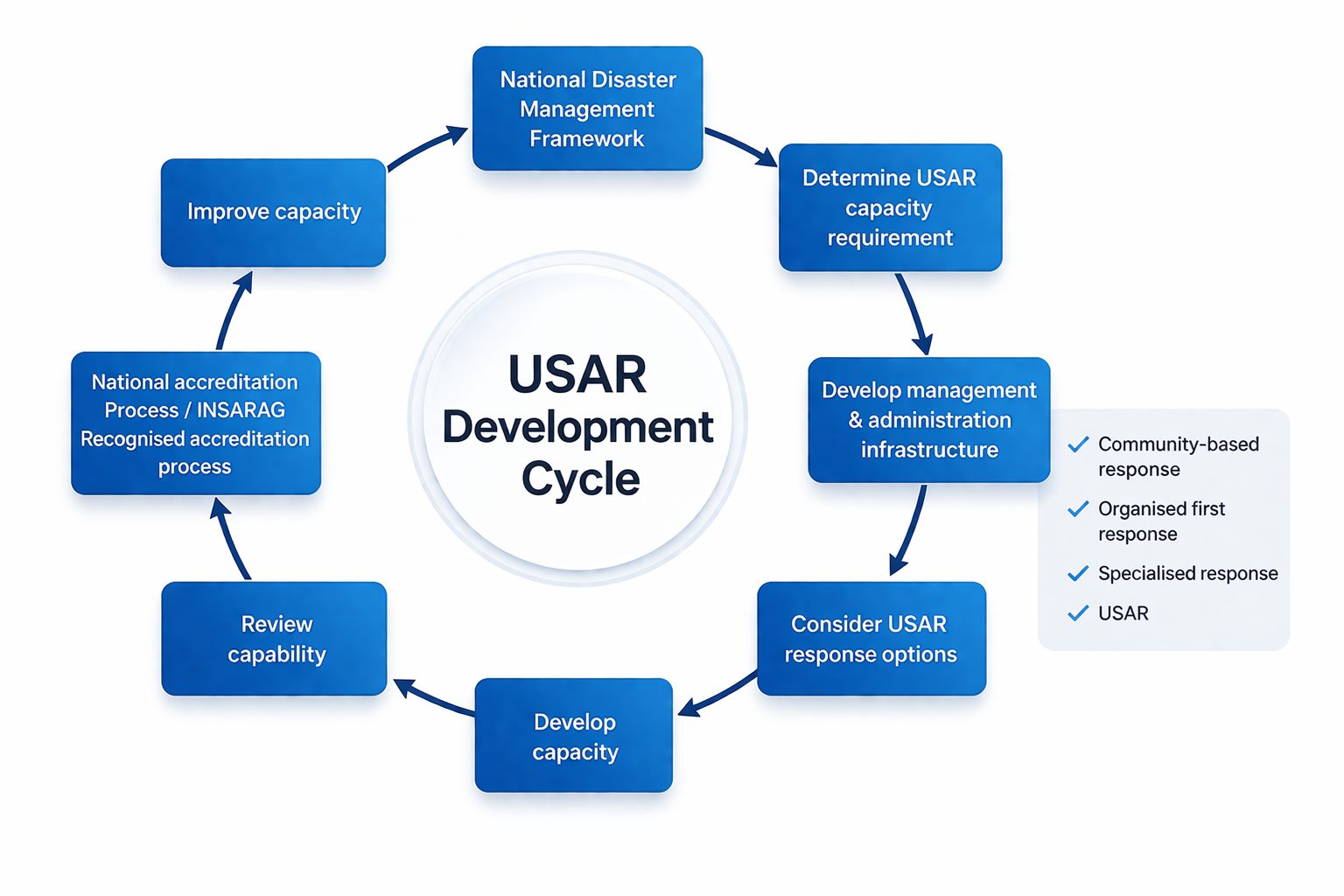
Countries developing a national USAR capacity are encouraged to adopt, at the appropriate level, the INSARAG Guidelines for building the capacity of national USAR Teams. This could serve as a target to be achieved. They may implement suitable processes for confirming the achievement of these standards, such as establishing a national accreditation mechanism. As an initial step, teams are strongly encouraged to self-assess their national USAR Team’s capacity.
These processes and steps are reflected in the USAR Development Cycle below.
Developing National USAR Management and Administration Infrastructure
Once the appropriate government officials (national, regional, and/or local) have identified the necessity for a national USAR capability, development planning should begin for the required USAR capacity. As efforts commence to establish the resource, the government should revise its legal framework for disaster response to encompass the proposed USAR capacity's management, administration, and utilisation infrastructure. This includes commitments to the system as a whole including future personnel and resources needed to continue to facilitate INSARAG's mechanisms supporting all teams globally. Information management is a prime example for this.
The system that is utilised to manage information for coordination is continually improved and maintained by the Information Management Working Group (IMWG). They are also charged with other information management tasks and tools, which is reflected in their Terms of Reference. In order to facilitate these tools and work, all INSARAG members are expected to contribute funds to access the INSARAG Coordination and Management System (ICMS). This programme is essential for coordination and information management and eventually result in more lives rescued.
It will be necessary to design the administrative and financial management tools for the USAR capacity. These documents ought to:
- Define the policy and procedures
- Make provision for initial or ‘start-up’ funding for the preparation of USAR disaster response
- Make provisions for ongoing annual funding that should be sufficient to allow the USAR capacity to maintain a high standard of operational readiness
- The administrative and financial documents should also define:
- The duties and responsibilities of management and administrative positions
- The organisational responsibilities and roles
- The process through which the USAR Team will administer annual funding
- The record management processes
- How property is accounted for
- How new members are selected
- How members receive initial training
- The ongoing training required to allow members to remain operational
Once an effective management and administration infrastructure is in place, the alternative response options need to be considered, which include:
- The approach selected should be based on the likely rescues (number and degree of difficulty) required in the event of a disaster and the ability to procure appropriate equipment, recruit appropriate people and train them (initially and ongoing).
- Most people rescued after a disaster are lightly trapped and recoverable by the first responders and USAR Teams available locally and quickly on the scene. Thus, it is critical to incorporate all response levels into disaster planning.
- Unless more complex and technical rescues are envisioned, there is no requirement to progress to another level and develop a more technically capable team.
- Structured teams with a medium or heavy capacity are more expensive to develop and maintain and are less quick to deploy than teams with light capacity. This is because assembling and moving their staff and equipment takes longer.
- National Disaster Management Framework for urban search and rescue response to identify risk scenarios and/or locations.
- The National Disaster Management Framework includes phases for mobilising and demobilising regional to national USAR-level resources to the disaster location.
When developing a local technical rescue team, it is often more effective and efficient to maintain a lower-level capacity than to attempt to create a larger-capacity resource without being able to sustain the necessary skill and equipment standards.
Structured teams have an advantage over untrained, spontaneous volunteers by offering an organised rescue capacity, thereby minimising the risk of injury or death for rescuers and the victims.
USAR Capacity Building Assessment Mission and Endorsement
Countries seeking assistance building USAR capacities can do so through INSARAG's extensive network of established USAR Teams. Such requests may be made bilaterally or through a submission to the INSARAG Secretariat, which will forward the request to interested donor countries for consideration.
Upon receiving a request to assist countries and organisations in the national USAR capacity-building process, the INSARAG Secretariat will facilitate an INSARAG USAR Capacity Building Assessment Mission at a mutually agreed-upon date. The mission will be conducted in collaboration with the host country and global USAR experts and is typically funded by donors, in-kind support, or the host country. Additionally, the Secretariat offers a USAR Capacity Assessment Methodology Guide to aid countries wishing to pursue this endeavour.
The mission's primary objective is to provide constructive feedback on the status of the host country’s national USAR capabilities and offer recommendations in line with the INSARAG Guidelines. The assessment is based on the five components of a USAR Team as required in the INSARAG Guidelines.
The mission may include interviews with key stakeholders, visits to several relevant sites, and observing a skills demonstration for compiling its findings. Please contact the INSARAG Secretariat at insarag@un.org for more details on the USAR Capacity Assessment Methodology User Guide.