Worksite Triage
The objective of ASR2 is to assess collapsed structures and identify viable sites for live rescues. The UCC will use this information to list sites in order of priority and decide which teams to assign to which sites. One of the considerations for the prioritisation of worksites is the triage category.
The objective of a triage process is to evaluate triage factors to compare collapsed structures and decide the order of priority. The key to triage is consistency in the comparison of triage factors.
Note: For Worksite Triage Marking go to INSARAG Marking and Signalling System
First order of priority: Triage Categories with Victim Information
The level of prioritisation of worksites is based on victim information: number of confirmed alive victims, number of possibilities of live victims, and if there are only dead victims in the structure. All worksites with confirmed live victims are complete before the structures with possible live victims. The worksites with the greatest number of victims are the highest priority. Buildings with dead only may be assigned to USAR Teams as part of ASR5.
In order to assist deciding which team goes to which site, the triage teams are requested to estimate how long the operations will take. The duration can only be estimated if the assessors have an idea of where the victim is located. Duration will depend on the structure, e.g., building material and size, and on equipment and expertise. The estimate should be based on general capability of a team and will always be a rough estimate. Duration estimates will allow the UCC to assign the larger teams to the move difficult or larger sites that take longer to complete. The UCC collects information on all confirmed and possible live victims. It does not collect victims on all deceased, only information that is deemed relevant.
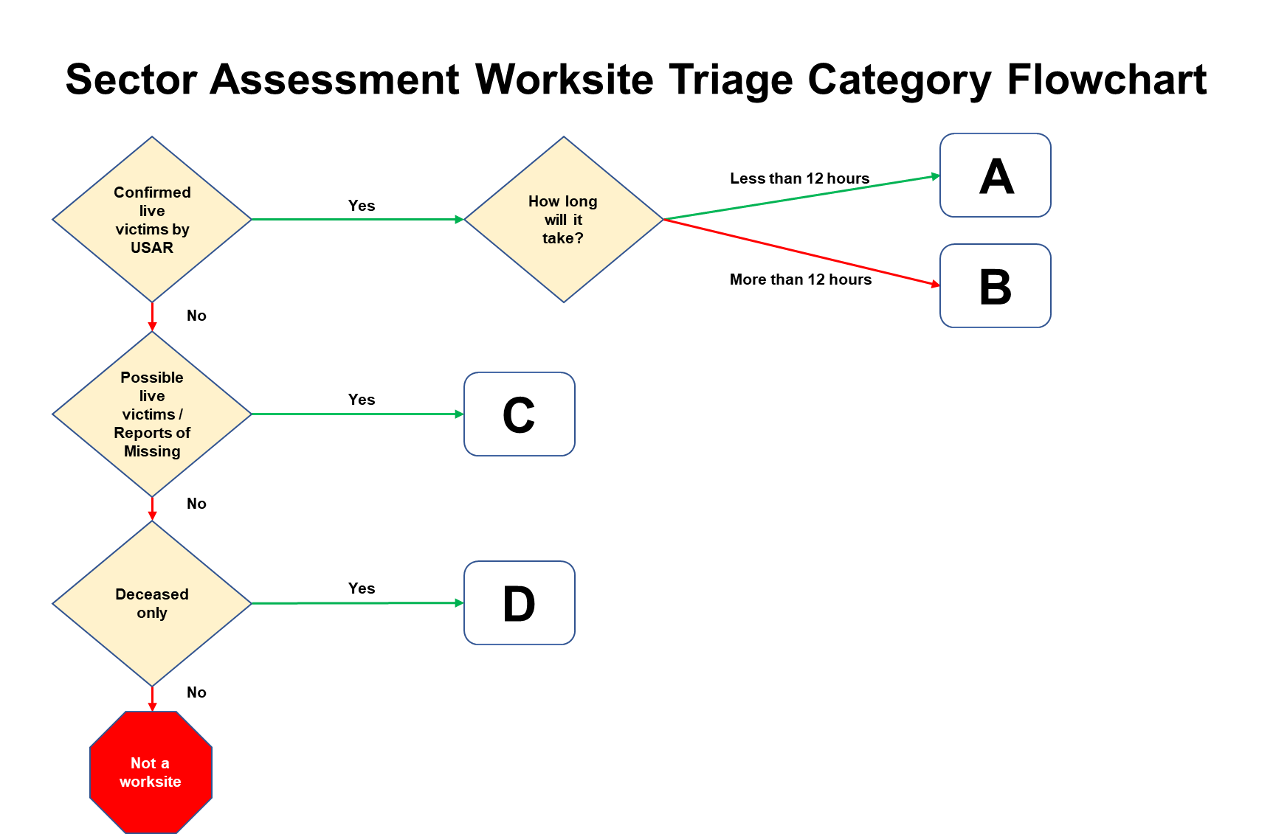
The above triage strategy leads to following four triage categories:
| Triage Categories | Victim Information | Expected Duration of Operation |
|---|---|---|
| A | Confirmed live victims | Less than 12 hours |
| B | Confirmed live victims | Longer than 12 hours |
| C | Possible live victims | Not assessed |
| D | Deceased only | Not assessed |
- Confirmed live victims: Means that the USAR assessment team knows that there are people alive in the collapsed structure.
- Possible live victims: Means that there is a possibility that people are alive in the structure, but the assessment team cannot confirm whether people are alive or even in the structure. Examples of possible live victims is when by-standers report missing people, or a collapse of a school that was in session.
- Deceased only: Means that there are not live victims, but the LEMA may want to send teams to the site to recover the bodies.
Second order of priority: Building Information and Operational Constraints
In cases where the UCC needs to use additional information to list the worksites in order of priority, building related and operations related information can be used. Examples of useful information is listed below. This are not placed in the triage categories to avoid the triage categories becoming complicated.
Building related information includes:
- Use: For example, a home, office, school, hospital, etc. will provide an indication of possible trapped victims.
- Size of site (footprint and number of floors): The larger the building, the longer the operation will take.
- Type of construction: The heavier the construction material, the longer the operation will take.
- Building Collapse Category:
- Inclined: One, some, or all of the columns and walls have collapsed in a way that floors collapse on an incline.
- Overturn: Part or all of the building has fallen to the side.
- Pancake: One, some, or all floors have collapsed completely.
- Debris heap: One, some or all of the floors, columns and walls have collapsed resulting in a heap of debris.
- Overhang: Lower parts of the building have collapsed, leaving the higher part of the building to hang over the lower part.
- Void space information may also be an issue, based on information from building collapse categories:
- Big void: When a space is big enough for a person to crawl. The chances of survival for a victim are greater in big voids than small voids. “Big” is a relative term, i.e. a big void for a child will be considerably smaller than a big void for an adult.
- Small void: When a person can hardly move and has to lie more or less still while waiting for help. In small voids, the chances of injury are higher as people trapped inside have less space to avoid falling objects and collapsing structural elements.
Factors relating to the operations include:
- Resource availability: The more limited resources, the longer the operation will take.
- Location of site and teams: The further from the site the team is, the longer the operation will take.
Worksite Triage Form
⬇ Download Worksite Triage Form
Building information
- Worksite ID
- GPS Coordinates
- Address
- Worksite boundary description
- Building use
- Construction material
- Floor area
- Number of floors
- Number of basements
Victim information
- Total number of live victims confirmed by team**
- Will the operation take less then 12 hours?
- Total reported missing (indicating possible live finds). If none put 0. If unknown leave blank
- Are there deceased? If yes, estimate on how many? If no put 0. If unknown leave blank.
- Assign a Triage Category
Describe the building collapse
This provides information about void spaces and structural stability. If relevant, describe local damages.
- Examples:
- Inclined
- Pancaked
- Debris heaps
- Overturns
- Overhang
Main USAR operations likely to be needed at this Worksite
- Type:
- Dog/Technical search
- Shoring and propping
- Breaking and breaching
- Lifting and moving
- Rope/height working
- Medical needs
- Number of personnel, equipment, time required, etc.
Risks/hazards/other info
Team information
- Team ID
- Date
- Time
- Completed by
- Name
- Title/position