National Accreditation Process (NAP)
A relevant component in developing national USAR capacity is considering a quality assurance mechanism, which may involve a National Accreditation Process (NAP). Such a mechanism enables a country to establish, monitor, and manage officially approved standards while adhering closely to the INSARAG guidelines in developing its USAR national response systems. In line with the INSARAG response framework, the establishment of a USAR NAP is strongly recommended. Within this context, it is important to distinguish clearly between classification and certification. The term classification refers to the INSARAG External Classification/Reclassification (IEC/R), which is an international assessment used to determine whether a USAR team meets the globally agreed INSARAG standards required for international deployment. Classification serves as the formal mechanism for ensuring alignment with the INSARAG Guidelines and for promoting interoperability among internationally deployable teams. The term certification refers to a country’s national accreditation system for its own USAR teams. National accreditation mechanisms are administered by the competent national authority to verify a team’s compliance with domestic standards, regulations, and operational requirements. In accordance with national laws and regulations, the national authority is responsible for establishing, implementing, and certifying that USAR teams meet these national requirements, which should, to the extent possible, be aligned with the INSARAG Guidelines but do not constitute, imply, or substitute for INSARAG classification.
NAP Objectives
The main objectives of implementing a national accreditation process for a member state are the following:
- Implementation of national standards
- Ensuring interoperability of resources
- Quality assurance process
- Accountability of all parties involved in the system
- Continuous learning cycle and improvement
- Sharing best practices
- Supporting and updating the policy framework
NAP Implementation
Strong political support and commitment need to be given to the development of the national accreditation framework to ensure a stable and sustainable process. Thus, the USAR programme should be integrated into the national disaster management system to guarantee its development, implementation, and funding completeness. Consequently, commitment to an accreditation system is a crucial prerequisite for the sustainability of standards. It should be an essential part of the member state’s national regulations to facilitate development and consolidation within public policy.
The following elements ought to be considered during the development of a national accreditation process:
- Focused planning of the process by the national authority to develop the accreditation system
- Identify stakeholder institutions or organisations that will participate in developing the accreditation process, including training national USAR Teams
- Appropriate, sustainable and qualified staffing for the development of the accreditation process
- Participation of all relevant national players is subject to the accreditation system to validate and support the accreditation process
- Transparency within the system and during the accreditation process
- Framework establishment
NAP Stakeholders
The involvement of USAR national stakeholders is crucial to ensure that the system has sufficient and pertinent representation.
National Disaster Management Authority (NDMA)
The NDMA should lead the national accreditation process, which forms part of
the national emergency and disaster management framework. Additionally, the NDMA
should incorporate accredited USAR teams into national emergency plans, including
protocols for alerting and mobilising USAR teams and the USAR response cycle.
Accrediting Entity
The NDMA, as the process lead, can mandate an accrediting entity or body through
an official document. Suitable entities may include an academy, a national fire
and rescue authority, or a civil protection organisation. The entity must ensure a
transparent and participative implementation process of the accreditation system.
This entity must further ensure that the development process is consistent with national needs and promote the development and professionalisation of USAR groups, taking advantage of the experiences achieved through the accreditation process.
Control mechanisms should be implemented within the accreditation process to ensure that relevant procedures are conducted transparently and that acceptable technical conditions have been provided.
Accreditation Technical Committee
An Accreditation Technical Committee should be established with a committed and
sustainable legal mandate, financial support, and the necessary technical conditions
for functioning. The competent national authority should create and recognise the
Committee through publicly available official documentation.
The Accreditation Technical Committee's main task is implementing and managing all aspects of the National Accreditation Process and developing relevant documentation for the accreditation system.
The composition of the Accreditation Technical Committee should include USAR representatives and experts in quality control or auditing. This committee's application and selection processes should be open and transparent to all qualified stakeholders. Procedures will govern the operations of the Accreditation Technical Committee in areas such as composition, organisational structure, scope, and methodologies, among others.
Sponsoring organisations
The USAR team's sponsoring organisations are responsible for its operations, which
may include funding and ensuring that the USAR team fully comprehends the
accreditation process and meets national standards.
National USAR Teams
The national USAR teams are crucial in ensuring their effectiveness and compliance
with established standards. Agreement with national standards is paramount, requiring
teams to align their operations with the accreditation criteria set by the relevant
authorities. Collaboration with national disaster management authorities and other
stakeholders is also key; USAR teams work closely with these entities to define roles,
responsibilities, and operational protocols necessary for effectively enhancing their
capabilities and contributing to establishing a robust national accreditation system
aligned with international standards.
Mentor
Each team should have a national mentor designated by the Accreditation Committee
to accompany and guide the national team through the process. Each USAR team could
participate in selecting the mentor, and the specific role and responsibilities of
the mentor should be clearly defined in the process.
Accreditation Team
Accreditation team members offer the necessary technical expertise to assess the
various components of a USAR Team during the accreditation process. In most cases,
they may deliver technical knowledge across multiple functions. The Accreditation
Technical Committee should outline the accreditation team’s composition, selection,
roles, and responsibilities.
NAP Assessment Objectives
The national accreditation process should provide the opportunity to verify compliance with national standards. Such standards should provide information on the critical elements required and the resource composition of USAR teams, which in turn should be consistent with the INSARAG guidelines. There should be standards for Light, Medium, Heavy USAR teams.
The accreditation process should assess two key components of USAR operations i.e., response capability and technical capacity.
Response Capability
The response capability assessment, including the decision-making role of the
sponsoring organisation, will assess a USAR team’s ability to monitor for sudden-onset
disasters, receive notification of a breaking emergency, mobilise its resources and
respond nationally in a timely manner.
Technical Capability
During an accreditation, the USAR team’s technical capacity will be assessed based
on how it performs USAR operations. This assessment will differ depending on whether
the team is attempting a light, medium, or heavy classification.
USAR teams are required to demonstrate proficiency using their full USAR technical capacity (skills and equipment) during a constantly evolving realistic structural collapse exercise of minimum 36 hours duration. The exercise challenges the USAR team’s ability to operate effectively in a simulated mission and timeline required for the desired classification level.
NAP Evaluation Process
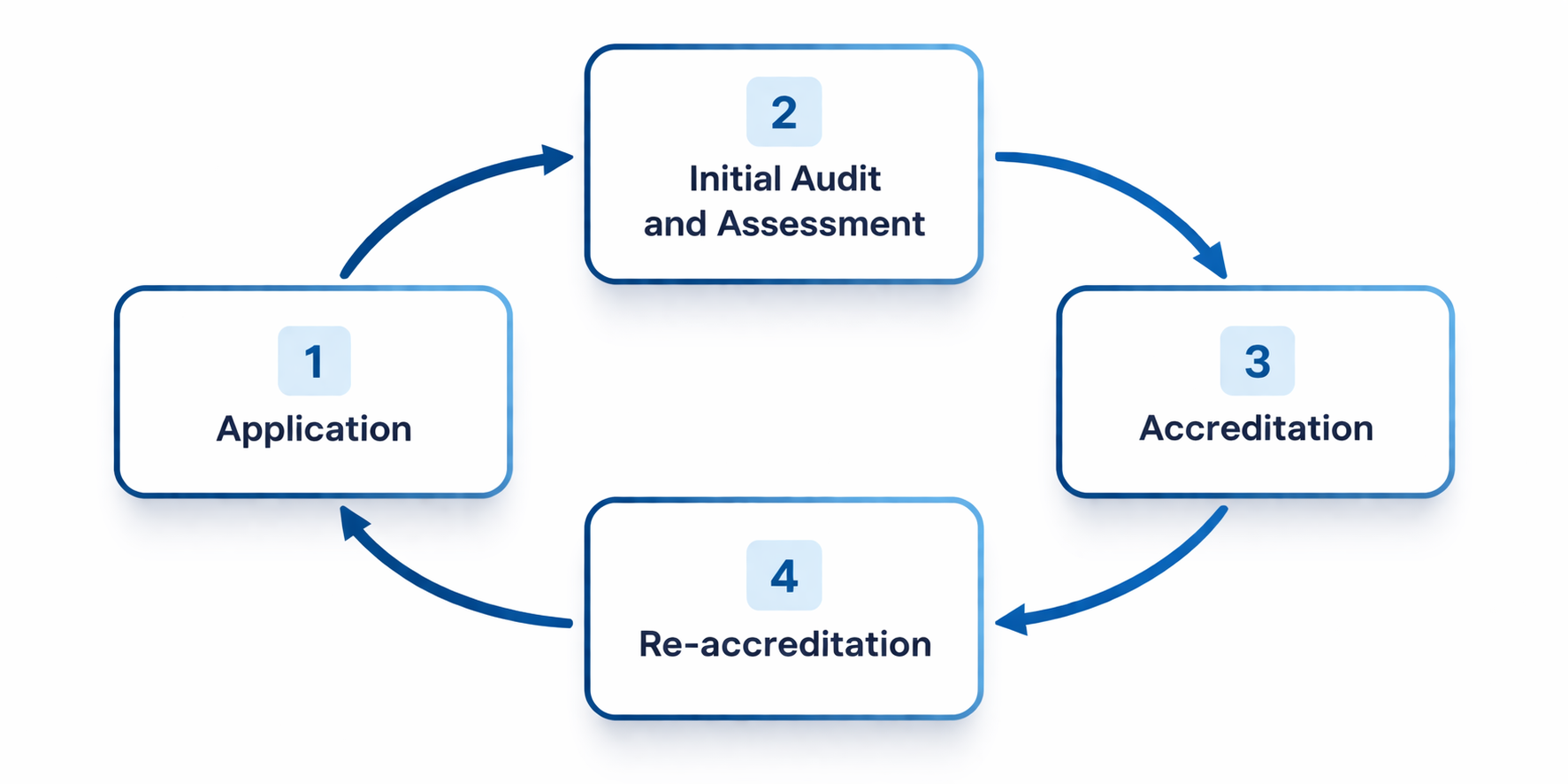
The NAP should consist of at least four stages, and the following sections describe general principles for its design, implementation, timeline and scheduling.
Team Application
The process shall include the team's self-evaluation and, subsequently, an internal
decision by team management and its sponsoring agency regarding the application to
the national accreditation process.
Once appointed, the NAP mentor will pre-assess the USAR team's capacity and capability to ensure it is prepared to start the accreditation process. In consultation with its mentor, the USAR team should develop a strategic plan to address any identified administrative or operational gaps. The implementation of this strategic plan needs to be undertaken considering realistic timelines.
The team must formally request to initiate the accreditation process and present the relevant documentation equivalent to the Portfolio of Evidence (PoE) of the IEC/R process. All the supporting documents should be requested at the beginning of the process. Alternatively, abbreviated and full versions of the documentation can be considered in two separate instances.
The accreditation technical committee should provide all standard application formats. USAR teams apply by completing forms that include all accreditation requirements. These requirements must conform to national standards and the INSARAG methodology. The accrediting entity provides these forms to ensure that the accreditation process guarantees uniform parameters for all applying teams.
Initial Audit and Assessment
The Accreditation Technical Committee nominates an accreditation team to assess the
USAR team and inform all involved parties.
The national standards and evaluation criteria should be publicly available. The process should have a verification tool (e.g., a checklist) that allows the USAR team to perform the self-assessment and serves as the instrument used by the accreditation team to verify compliance with national standards.
The process should include an administrative audit of the information and documentation presented by the USAR team (e.g., the portfolio presented), based merely on documents to identify non-conformities. The process shall include an initial visit to the team’s main infrastructure to review the team's capacities, as declared in the portfolio. This visit should include where the team’s home base is to observe its capacities, including the administrative element, equipment, procedures, staff, logistics, etc.
The field exercise (FIELDEX) should evolve continuously over a minimum of 36 hours. The scenarios should enable the accreditation team to observe all the operational and administrative requirements of the verification instrument. This FIELDEX must incorporate all aspects of disaster response, from breaking the emergency to demobilisation and returning to home base.
Accreditation
The accreditation team should report to the Accreditation Technical Committee.
The reporting should be standardised and include an assessment report with a
recommendation to the Committee and a completed verification tool that reflects the
accreditation team’s assessment and recommendations. The process shall culminate in
the team’s certification, formal and identifiable recognition, and commitment to form
part of the national response assets.
Re-accreditation
The re-accreditation should occur, at most, within the fifth calendar year following
the original accreditation. The Accreditation Technical Committee shall establish
the exact term of the re-accreditation. A five-year term is the recommended practice.
The Accreditation Technical Committee shall establish clear and transparent reasons why a team might need re-accreditation. However, re-accreditation should occur for any of the following reasons:
- Expiration of the accreditation period
- Change in USAR team structure
- Change in accreditation level
- Inappropriate response conduct
Four stages of a National Accreditation Process.
National Responsibilities
The member state shall have a national USAR team directory of accredited teams, and the team shall be included in the INSARAG directory as a national USAR team.
Once a national USAR team is recognised by its national authorities, the INSARAG Policy Focal Point may inform the INSARAG Secretariat if desired. The INSARAG Secretariat will register this team as a “nationally accredited USAR team” at the light, medium, or heavy level in the USAR Directory.
Member states may decide to issue nationally accredited teams with standardised patches. This has two purposes: to ensure the standardisation of recognition and visibility and to inform other national and international responders of the teams’ capacities.
Note: Any external confirmation is voluntary, optional, and complementary to national processes. It should not be confused with the IEC process, which remains the only classification system for a USAR team planning to deploy internationally.