Community & First Responders
Emergency services (both volunteer and career), civil protection, militaries, and many non-governmental organisations (NGOs) have taken on a major role as primary responders to rescue incidents. Rescues can involve structural collapses, trench collapses, confined spaces, industrial and agricultural machinery, water emergencies, and individuals trapped above or below grade level, which are grouped into a category known as technical rescue.
Technical rescue incidents are complex and require specially trained personnel and equipment to complete the mission. Natural forces such as earthquakes, precipitation, extreme temperatures, and swift water currents can complicate these incidents further. The presence of flammable vapours and toxic chemicals can also elevate the level of risk.
The safety of teams conducting technical rescue operations is of special concern. First responders worldwide perform technical rescues daily. Some complex technical rescue incidents may last many hours or even days as rescue personnel carefully assess the situation, obtain and set up the appropriate rescue equipment, monitor scene safety, and remove hazards before reaching, stabilising, providing emergency care and extricating the victims.
Hazardous substances or elements, such as flammable vapours or dust, often force rescuers to take additional precautions to ensure operations are conducted safely. Experience has shown that hasty rescue operations can endanger the lives of both rescuers and victims. At the same time, rescuers know that a victim’s survival chances often depend on the rapid provision of emergency medical care and extrication. Some organisations are better prepared than others to perform technical rescue operations. Many organisations have created specialist technical rescue teams for complicated rescue operations. A technical rescue team is a specialised group of personnel with advanced training and specialised equipment to safely and efficiently conduct complex rescue operations.
Considering the mandate, the specialities and capabilities of individual teams vary greatly, depending on their level of training, number of trained personnel, and availability of specialised rescue tools and equipment. For example, some organisations have the training and equipment to perform rescues at collapsed structures by cutting through reinforced concrete and removing heavy debris. However, other teams are limited to working with picks and shovels to remove debris.
Many organisations have single-discipline rescue teams, such as a water rescue team. These teams are trained and equipped to handle one type of rescue. Others have multi-disciplinary teams capable of performing more than one type of rescue operation.
INSARAG Response Framework:
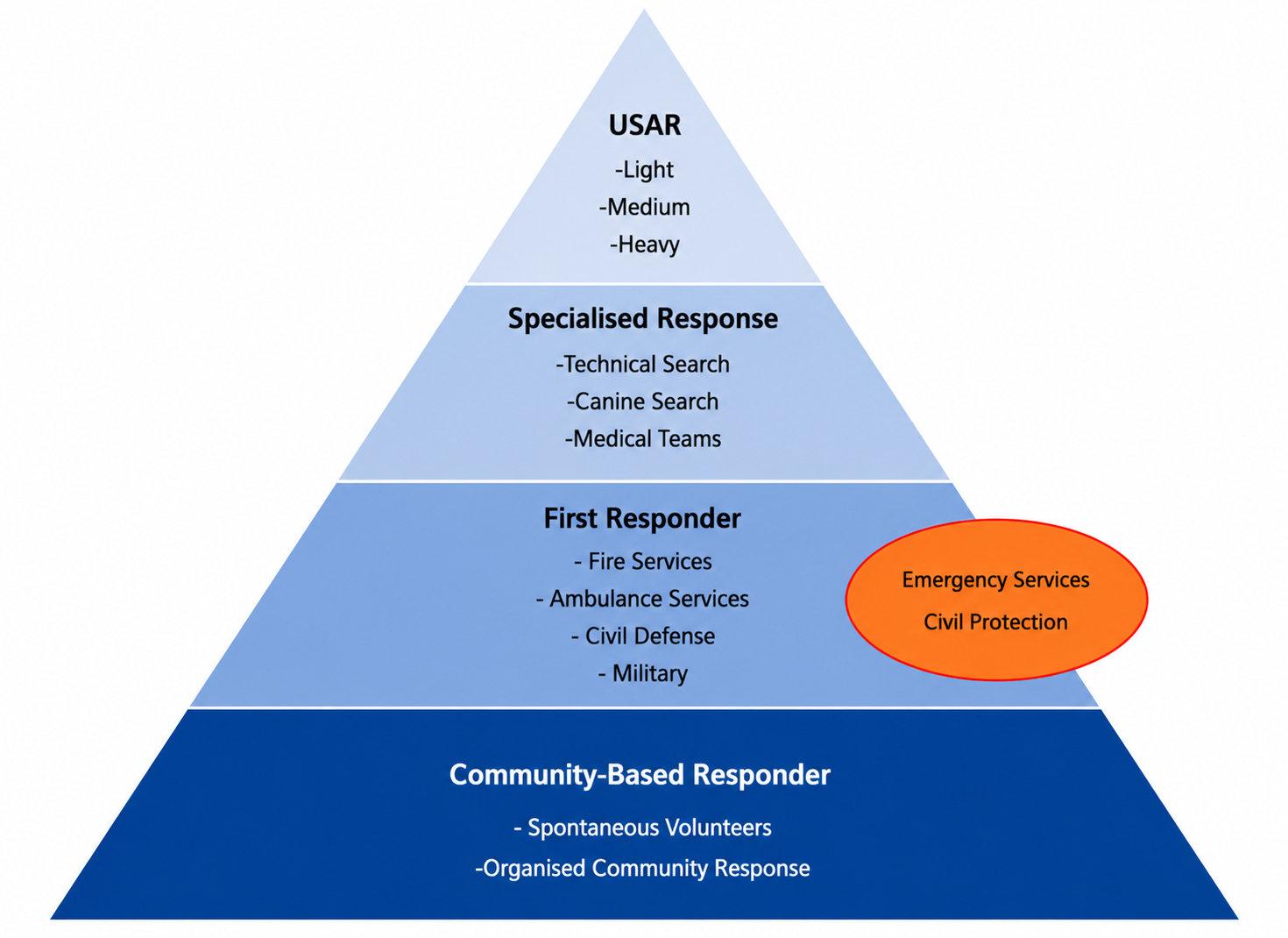
Community-Based Responder
The organisation of community responders is usually the first step any community or organisation takes to equip and train itself to respond to an emergency. This organisation comes in various shapes, sizes, and capabilities and is primarily determined by the types of risks or hazards the community faces. Often, these teams are made up of non-professional volunteers. The INSARAG Community Responders Programme guides the establishment of this tier of response.
First Responders
First responders refers to entities officially recognised as organised responses typically provided by fire services, emergency medical services (EMS) personnel, civil protection units, police, etc. These entities may be composed of volunteers or career professionals, but all are recognised as professional organisations. The INSARAG First Responders Programme, available at www.insarag.org, guides the establishment of this tier of response.