USAR Team Training and Roles
USAR Training Development Methodology
Training and development, including initial, joint, and reclassification, are essential for successfully implementing any local USAR capacity-building project and must address all the team components.
The USAR management and administration infrastructure is responsible for developing a standardised process to identify training needs.
This might include:
- Identification of existing resources, procedures and competencies
- Self-evaluation to determine actual operational capacity
- A gap analysis will be conducted to identify training requirements
- Identification of pre-conditions for training to be effective
Unlike the single role of the USAR first responders, developing USAR Teams requires training in the different roles that make up a team. Therefore, to support the development of USAR Teams worldwide, INSARAG recommends a training methodology in which training is linked to an individual’s position within a USAR Team.
Each functional position within a USAR Team has been identified, and role descriptions have been developed. These role descriptions are common across all levels of USAR Team capacity, with variations to accommodate different levels of skill and knowledge.
INSARAG recommends generic training requirements linked to team positions and role descriptions within the USAR Team structure. The training requirements are grouped into USAR Modules, which facilitate organisations' development of USAR capacities.
USAR Training Methodology:
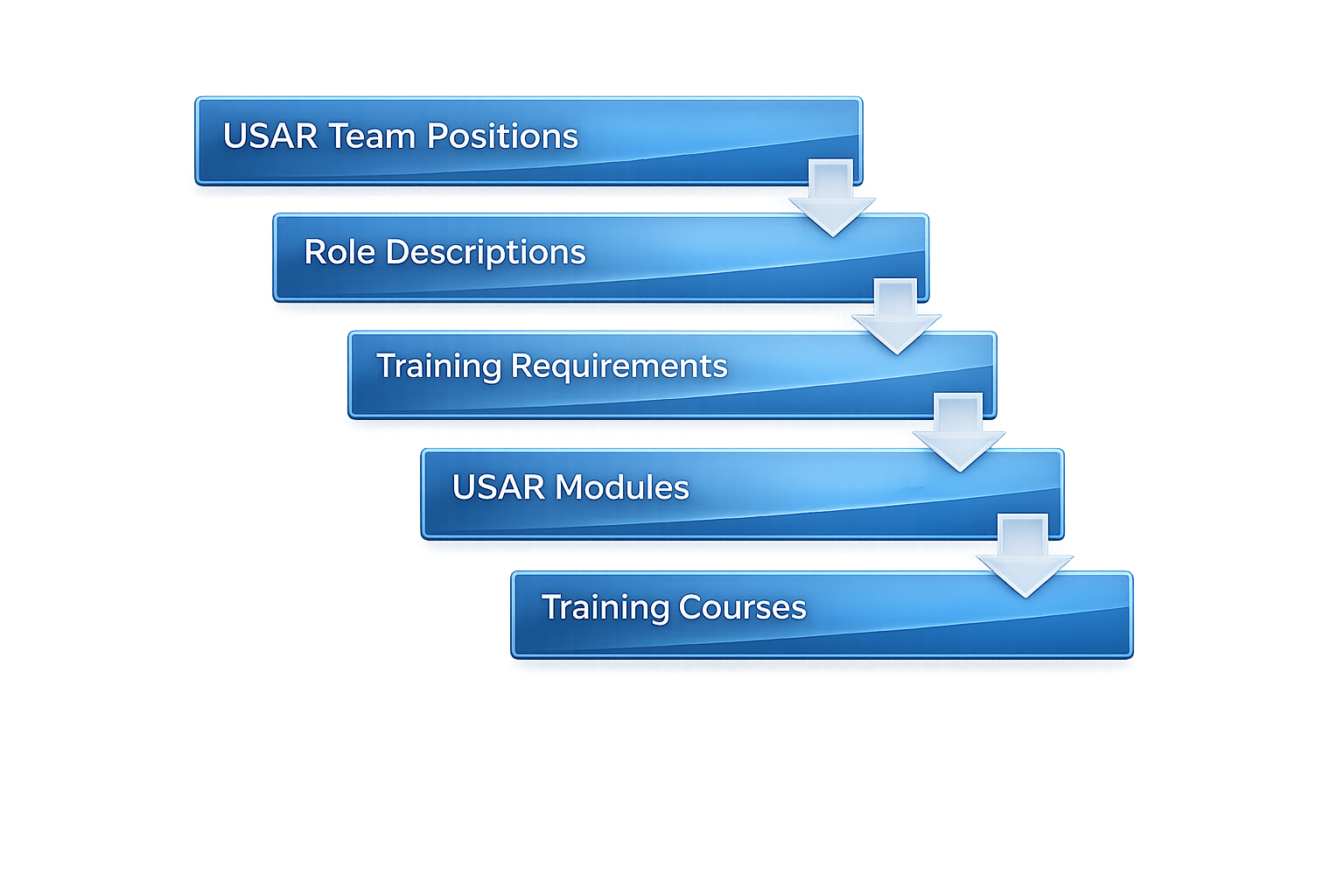
Team Positions
To be effective, USAR teams must perform various roles within the team structure. Each functional position in a USAR team is identified.
There are 17 identified positions based on the five components of USAR Teams:
| USAR Component | Position | Function |
|---|---|---|
| Management | Team Leader | Command |
| Deputy Team Leader/Operations Officer | Coordination/Operational Control | |
| Planning Officer | Planning | |
| Liaison Officer/Deputy Liaison Officer | Liaison/Media/Reporting/RDC/UCC | |
| Structural Engineer | Structural Assessment/Analysis | |
| Safety Officer | Safety/Security | |
| Search | Technical Search Specialist | Technical Search |
| Search Dog Handler | Dog Search | |
| Hazmat | Hazmat Assessment | |
| Rescue | Rescue Team Officer | Breaking/breaching/cutting/shoring/technical rope |
| Rescuer | Breaking/breaching/cutting/shoring/technical rope | |
| Heavy Rigging Specialist | Lifting/Moving | |
| Medical | Medical Component Manager | Oversight of medical component |
| Paramedic/Nurse | Team, dog care and entrapped patient care | |
| Logistics | Logistics Team Manager | BoO Management |
| Logistics Specialist | Food and water supply/base camp operations /transport capacity/fuel supply | |
| Communications Specialist | Communications |
Not all teams will include every identified position, and some may encompass more, depending on the specific local requirements of the team structure and whether it is classified as Heavy, Medium, or Light. The SOPs applicable in their respective countries must be carried out consistently in each defined role and function.
Management
Team Leader/Deputy Team Leader
Prerequisites
- Occupy an existing senior management position in the home organisation
- Understanding of INSARAG methodology
- Registered user of VOSOCC
- Functional English and cultural awareness
- Completion of UN BSAFE security awareness course
Roles & Responsibilities
- Overall command of strategy, tactics, and safety
- Comprehensive knowledge of all USAR Team functions
- Supervise internal and external coordination
- Personnel management: communication, cooperation, coordination, negotiation, conflict resolution, critical incident debriefing, staff welfare
- Strategic and tactical planning, media interaction, financial oversight
Planning Officer
Prerequisites
- Senior management experience
- INSARAG methodology understanding
- VOSOCC user
- Computer literacy and GIS applications
- Functional English, cultural awareness
- UN BSAFE course completion
Roles & Responsibilities
- Collect, collate, and analyse operational data
- Develop and disseminate visual and written Plans of Action
- Monitor plan implementation, recommend revisions
- Internal coordination and support for staff welfare
- Record keeping, reporting, and post-mission documentation
Operations Officer
Prerequisites
- Senior management position
- Understanding of INSARAG methodology
- VOSOCC user
- Functional English, cultural awareness
- Documented USAR operations experience
- UN BSAFE course completion
Roles & Responsibilities
- Operational control and tactical decision-making
- Implement operational Plan of Action
- Coordinate with local resources, LEMA, NGOs
- Crew accountability, risk mitigation, and resource allocation
- Maintain operational records and post-mission reports
Liaison Officer
Prerequisites
- Management experience in home organisation
- Prior liaison experience
- Understanding of UNDAC methodology, UN Cluster System, INSARAG principles
- VOSOCC user
- Functional English and cultural awareness
- Computer literacy and UN BSAFE completion
Roles & Responsibilities
- Represent USAR team in joint operations and coordination with local and international partners
- Participate in planning, implementation, and monitoring of operational plans
- Media engagement and information management
- GPS awareness and post-mission reporting
Safety Officer
Prerequisites
- Certified Safety Officer
- Management experience
- UN BSAFE course completion
- Functional English and cultural awareness
Roles & Responsibilities
- Oversee team safety and enforce PPE compliance
- Internal coordination with Team Leader, Medical Manager, Hazmat Technician
- Implement risk mitigation and crew accountability
- Fatigue management, hygiene, and rest/recovery oversight
- Record keeping and post-mission safety reporting
Logistics
Logistics Manager & Logistics Technician
Prerequisites
- Management or technician experience in logistics
- VOSOCC user
- Computer literacy and UN BSAFE completion
Roles & Responsibilities
- Accountable for tools, equipment, and resource management
- Coordinate transport, supply, and base-of-operations logistics
- Financial delegation
- Record keeping and post-mission logistics reporting
Communications/IT Specialist
Prerequisites
- Communications/IT experience
- VOSOCC user
- Functional English and UN BSAFE completion
Roles & Responsibilities
- Maintain communications within the team, with local authorities, and internationally
- Operate and maintain IT, UHF/VHF radios, and geospatial technologies
- Information management and post-mission reporting
Rescue Operations
Rescue Team Officer/Rescue Technician
Prerequisites
- Operational management experience
- USAR certifications
- UN BSAFE course completion
Roles & Responsibilities
- Lead and supervise tactical rescue operations
- Ensure team welfare, safety, and adherence to operational plans
- Tactical problem-solving and operational control
- Communication and post-mission operations reporting
Hazmat Technician
Prerequisites: Certified Hazmat Technician
Roles & Responsibilities
- Monitor hazardous substances and environmental conditions
- Implement gross and technical decontamination
- Maintain Hazmat equipment
- Tactical problem-solving, enforce safety standards, and post-mission reporting
Rigging Specialist
Prerequisites: Knowledge of heavy equipment and construction/demolition methods
Roles & Responsibilities
- Supervise rigging, lifting, anchoring, and shoring operations
- Ensure safety in heavy lifting scenarios
- Coordinate with engineers and provide tactical solutions
Search Operations
Technical Search/Search Dog Handler
Prerequisites: Certified technical search or dog handler
Roles & Responsibilities
- Conduct search operations using dogs, cameras, and listening devices
- Map, grid, and locate victims
- Maintain tools and equipment
- Coordinate with Rescue Officers and Operations Officer
- Post-mission reporting
Medical Operations
Prerequisites: Licensed medical professionals (doctor, nurse, paramedic)
Roles & Responsibilities
- Provide medical care for team members and search dogs
- Deliver emergency care to victims until handover to local medical authorities
- Monitor team health and advise on safety and environmental hazards
- Prepare post-mission medical reports
Structural Engineer
Professional Certification and Qualifications
A Structural Engineer must possess a recognised Bachelor’s degree in Engineering as the foundational step toward professional certification. In most countries, the degree programme must be accredited by a national or international professional engineering body. Following graduation, the engineer must complete defined requirements, including:
- Documented professional experience under supervision;
- Successful completion of professional examinations or assessments;
- Demonstration of competency in engineering ethics and practice
Upon fulfilling these requirements, the engineer attains professional certification, designated by titles such as:
- Professional Engineer (P.Eng / PE) – United States, Canada, South Africa;
- Chartered Engineer (CEng) – United Kingdom and other Commonwealth countries;
- Chartered Professional Engineer (CPEng) – Australia, New Zealand;
- European Engineer (Eur Ing) – within the European Union
Training Requirements
The recommended training requirements are performance-based and described in terms of learning outcomes and performance criteria. These criteria set out a minimum level of training outcomes suitable for USAR personnel at the identified levels.
It is strongly recommended that the different positions and components also train together to ensure optimal operational results.
Once a USAR Team has been certified by its government for national response, careful analysis should be conducted to determine whether the team should be included in that government’s planning for international assistance to collapse structure incidents.
Training
Hazmat First Responder Training
Training includes:
- Hazmat recognition
- Emergency Response Guide (ERG) usage
- Safety and health considerations
- Initial control and incident management
Incident Command System (ICS) Training
Training includes:
- ICS principles and structure
- Facility management and resource allocation
- Action planning, activation, demobilisation, and operational closure
Basic USAR Training
Training includes:
- Introduction to USAR and risk assessment
- Heavy lifting, shoring, ropes, and knots
- Ladder rescue, backboard securing, patient packaging
- Search methods and INSARAG marking
INSARAG Guidelines and Principles
Training includes:
- Protocols, guidelines, and procedures
- Unified Coordination Centre (UCC) awareness
- Minimum training standards for Light, Medium, and Heavy USAR Teams