International USAR Response Cycle
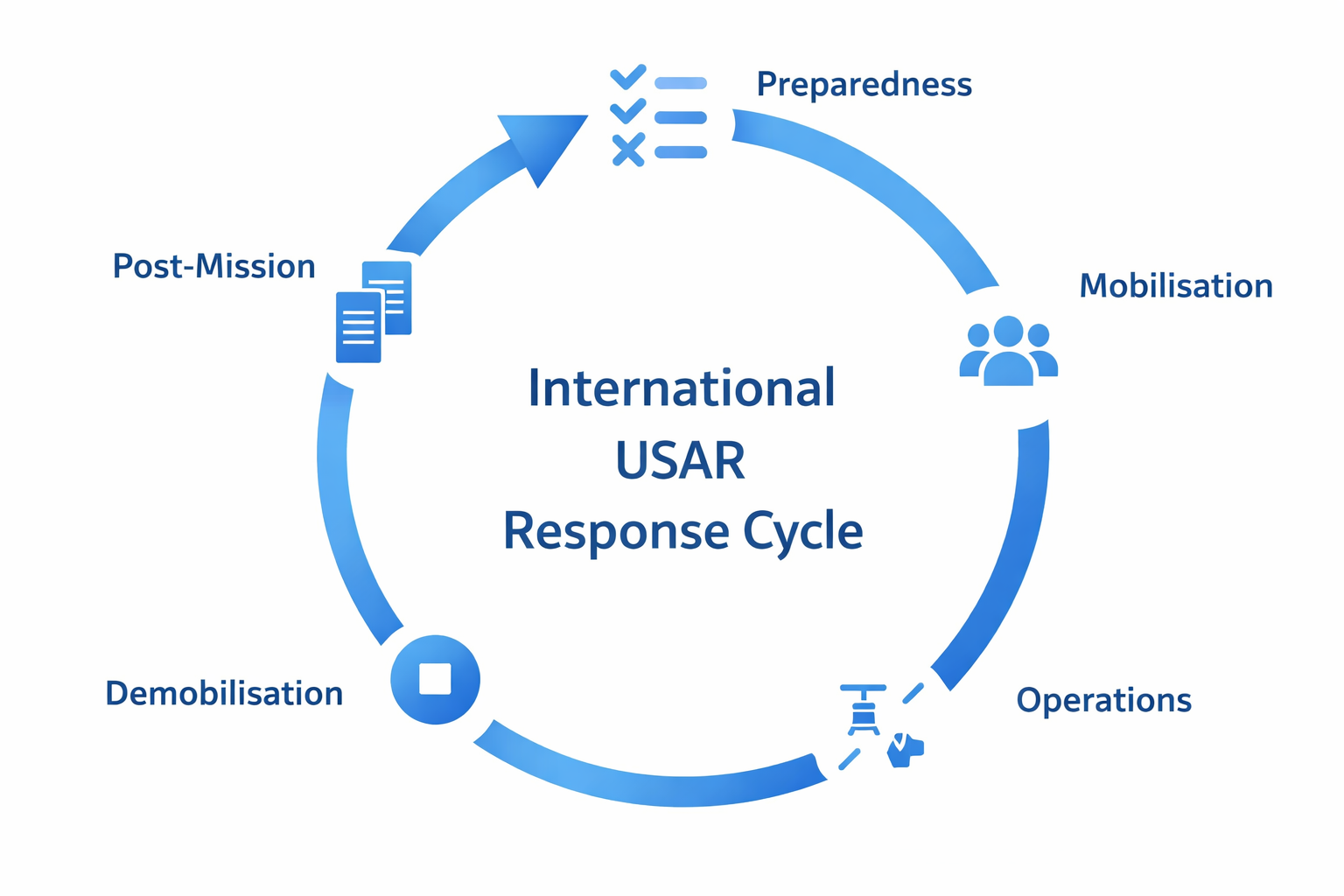
An international USAR response has the following phases:
Preparedness
The preparedness phase is the period between disaster responses. In this phase USAR teams undertake preparatory measures to ensure that they are at the highest level of readiness for deployment as possible. Teams will conduct training and exercises, review lessons-learnt from previous experiences, update Standard Operating Procedures (SOPs) as required, and plan future responses.
Mobilisation
The mobilisation phase is the period immediately following the occurrence of a disaster. International USAR teams prepare to respond and travel to assist the affected country.
Operations
The operations phase is the period when international USAR teams are performing USAR operations in the affected country. It starts with arrival of a USAR team at the Reception/Departure Centre (RDC) in the affected country, registration with the UCC/OSOCC, reporting operational intelligence to the UCC, who in turn provides it to the Local Emergency Management Agency or National Disaster Management Authority (LEMA), and performing of USAR operations. The phase ends when the USAR team is instructed to end operations.
Demobilisation
The demobilisation phase is the period when international USAR teams have concluded operations, commence withdrawal, coordinating their departure through the UCC/OSOCC, depart from the affected country through the RDC, and travel to their home country.
Post Mission
The post mission phase is the period immediately after a USAR team has returned home. In this phase the USAR team is required to complete and submit a post-mission report and conduct a lessons learned review to improve the overall effectiveness and efficiency for response to future disasters. The post mission phase continuously merges into the preparedness phase.