Roles and Responsibilities
This section lists those involved in the international USAR response cycle and what is to be expected of each party, including the parties from the affected country.
The United Nations Office for the Coordination of Humanitarian Affairs (OCHA)
The United Nations Office for the Coordination of Humanitarian Affairs (OCHA) is mandated to coordinate international assistance in disasters and humanitarian crises exceeding the capacity of the affected country.
Many organisations, such as governments, non-governmental organisations (NGOs), UN agencies and individuals, respond to disasters and humanitarian crises. OCHA works with all participants and responds to disasters to assist the government of the affected country in an effort to ensure the most effective use of all international resources.
OCHA serves as the INSARAG Secretariat. The INSARAG Secretariat is situated in the Response Support Branch in OCHA-Geneva, Switzerland.
More on OCHA and the mechanisms OCHA offers for emergency response can be found at UN OCHA.
UN Disaster Assessment and Coordination (UNDAC)
The UNDAC team is an OCHA tool used for deployment to sudden-onset emergencies. OCHA dispatches an UNDAC team when requested to do so by the affected government or the UN Resident Coordinator in the affected country. UNDAC team personnel are available around the clock and are able to respond at very short notice. The UNDAC team is provided as in-kind help to the affected country.
UNDAC team members consist of trained emergency managers from countries, international organisations and OCHA. The UNDAC team is managed by Response Support Branch (RSB), which sits within OCHA, and works under the umbrella authority of the Resident Coordinator and in support of and in close cooperation with the LEMA. The UNDAC team assists the LEMA with the coordination of international response, including USAR, assessments of priority needs, and information management, by establishing an OSOCC, if one has not already been established, or assumes control of the LEMA.
INSARAG Secretariat
The INSARAG Secretariat is situated in the Emergency Response Section of the Response Support Branch in OCHA-Geneva, Switzerland. The task of the INSARAG Secretariat is to help organise INSARAG meetings, workshops, INSARAG IEC/Rs and training events in cooperation with host countries.
In addition, the INSARAG Secretariat is responsible for the follow-up and the facilitation of any projects that have been agreed upon and launched by the INSARAG network.
Key functions of the INSARAG Secretariat are as follows:
Preparedness
- Advocate and promote international USAR preparedness
- Facilitate and coordinate the development of internationally accepted USAR methodology and description of the minimal standards for international USAR operations
- Act as point of contact for INSARAG related issues within the UN
- Maintain the international USAR Directory on the INSARAG website
Mobilisation
- Activate the VOSOCC
- Provide continuous updates regarding casualties and damage, entry points and procedures, and specific requests for assistance
- Inform all international participants of any special cultural, religious or traditional practices of the affected country, weather, safety and security issues
- Work closely with the affected country to expedite the timely and specific request for international assistance
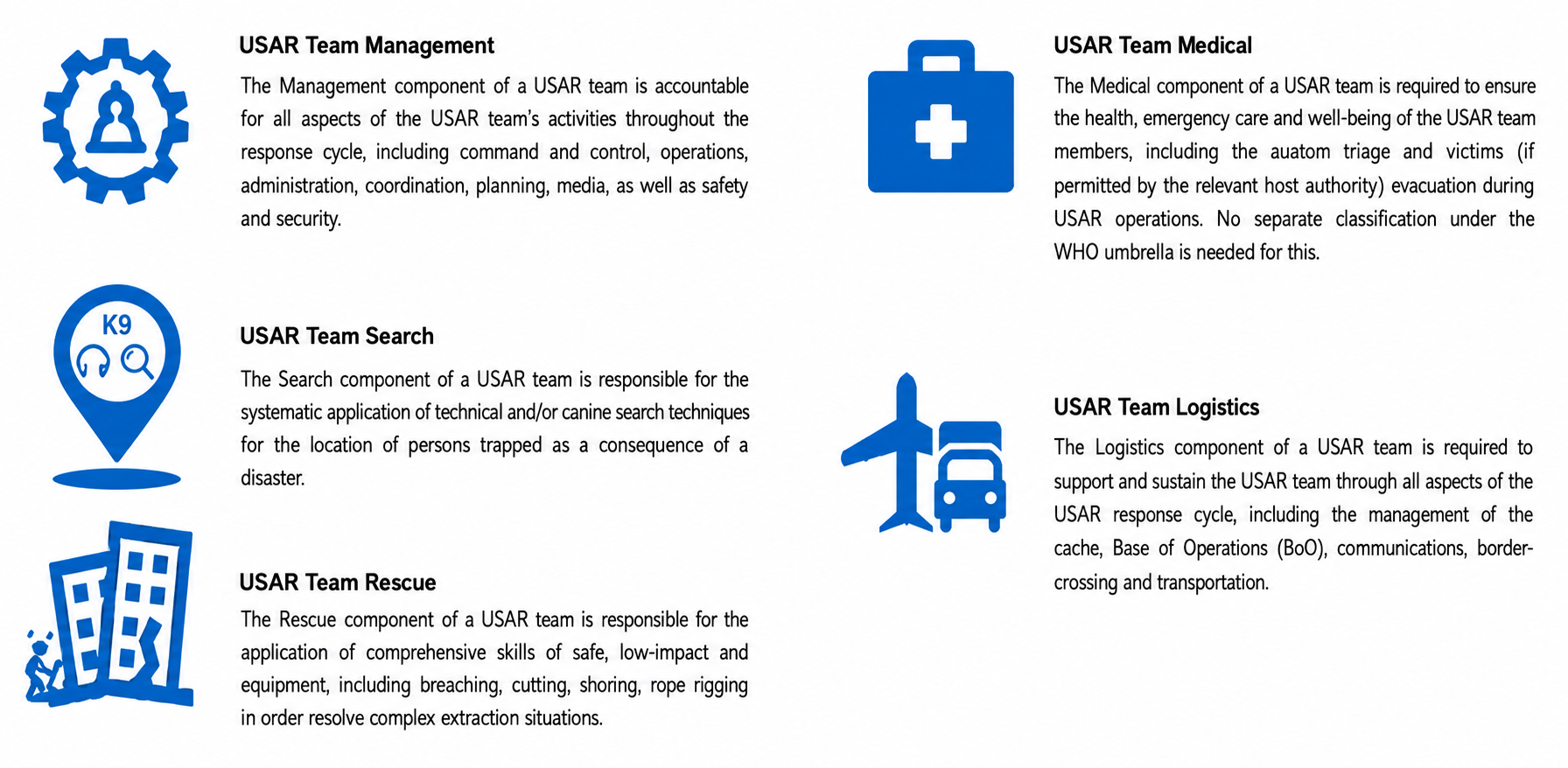
- Communicate to affected country that classified USAR teams are comprised of 5 essential components. Placing restrictions on any of the components will impact the donor’s country decision to deploy
- Communicate with UN representatives in the affected country
- Deploy an UNDAC team if required and request UNDAC Support Modules, as required
Operations
- Moderate the VOSOCC and post regular situation updates
- If not already done by the affected country/USAR teams, advocate to establish and maintain an RDC and UCC
- Provide support to the UNDAC team as required
- Request additional UNDAC support modules as required
Demobilisation
- Moderate the VOSOCC and post regular situation updates
- Provide support to UNDAC as required
Post-Mission
- Perform an analysis of USAR team operations taking into consideration the Post Mission Reports from all USAR teams present
- Convene a lessons learned meeting with all stakeholders, if necessary
- Disseminate the report of the lessons learned meeting to all stakeholders and post it on the INSARAG website
- Advocate to the ISG for eventually update and or create new decisions, according to lessons learned and feedback (Analysis, Post-Mission Reports, etc.) collected from teams, to merge into preparedness phase and hence close the loop
Affected Countries
Affected countries are those that experience the sudden-onset disaster. UN General Assembly Resolution 57/150 recognises the important role of affected countries in streamlining processes to ensure the timely response of responding international teams as well as ensuring safety of the teams.
UN Resolution 57/150, 16 December 2002
“Urges all States, consistent with their applicable measures relating to public safety and national
security, to simplify or reduce, as appropriate, the customs and administrative procedures related
to the entry, transit, stay and exit of international urban search and rescue teams and their
equipment and materials, taking into account the Guidelines of the International Search and
Rescue Advisory Group, particularly concerning visas for the rescuers and the quarantining of
their animals, the utilisation of air space and the import of search and rescue and technical
communications equipment, necessary drugs and other relevant materials;
Also urges all States to undertake measures to ensure the safety and security of international urban search and rescue teams operating in their territory.”
Key functions of affected countries are as follows:
Preparedness
- Identify when international assistance may be required by analysing national risks and possible gaps in resources
- Develop the capacity to conduct immediate situation and needs assessment. Identify priorities and report these to the international community
- Implement and maintain a process for requesting international assistance in a timely manner
- Implement and maintain procedures for receiving international teams into the country, including:
- Establishment of an RDC
- Visa assistance, which enables rapid entry of international USAR teams into the country, and, if possible, exemption of relief personnel from visa regulations and immigration inspections
- Entry and exit permissions, with exemptions from custom duties, taxes and other changes for:
- Specialised communications equipment
- Search, rescue and medical equipment
- Search dogs
- Emergency medical pharmaceuticals
- Temporary authorization to practice:
- USAR medicine
- USAR engineering
- Simplified and minimal documentation for export, transit and import, to reduce or waive inspection requirements where possible
- Prepare to support the logistics requirements of USAR teams, including interpreters, guides, fuel, transport, shoring timber, water, maps, and possible Bases of Operations (BoO) locations
- Prepare country briefings and fact sheets, to be used by incoming USAR teams
- Address questions of liability
- Develop a capacity to post regular updates and briefings to the VOSOCC
Mobilisation
- When required, make the request for international assistance as soon as possible. Requests for international assistance can be directed through various channels, namely through their UN RC’s office, the OCHA country of regional offices, directly through the INSARAG Secretariat, other regional networks, or on a bilateral basis.
- Advise when no additional international USAR teams are required to arrive
- If possible, establish an RDC, otherwise promote and help the first arriving teams in doing so
- Provide incoming teams with a BoO location
- Conduct immediate situation and needs assessments. The priority needs of international assistance should be identified and the information passed to the international community as soon as possible through OCHA and the VOSOCC. Highlight restrictions (e.g. no dogs allowed to enter the country, required vaccinations) to responding teams.
- Highlight restrictions to responding teams, recognizing this may impact the donor country to deploy their team(s)
- Provide regular situation updates on the VOSOCC, including casualties and damage, entry points and procedures, specific requests for assistance and to inform all international participants of any special cultural, religious or traditional habits of the affected country, weather, safety and security issues
- Provide or conduct briefings to arriving international USAR teams on the LEMA structure, in the country situation and safety
Operations
- Maintain representation at the RDC and the UCC/OSOCC to ensure a coordinated response and that national priorities are met
- Utilise international coordination mechanisms provided by UNDAC teams, and the RDC and UCC structures
- Establish mechanisms to integrate international USAR teams into ongoing national operations
Demobilisation
- Declare the end of the USAR operations phase. This is a policy decision that can be very sensitive because of its consequences. Indicators can be meteorological circumstances, degree of damage, last live victims rescued.
- Provide logistical support to assist the withdrawal of international teams
- Facilitate (as required) USAR team transition into other humanitarian operations
- Facilitate donation of USAR team equipment left for the affected government
Local Emergency Management Authority (LEMA)
The LEMA is the ultimate responsible authority for the overall command, coordination and management of the response operation. All responding USAR teams (regional and international, classified or non-classified) are required to report to the RDC upon arrival in the affected country, so that LEMA can be notified. Teams should then be briefed and deployed to the disaster site(s) by the UCC.
International USAR Teams
International USAR teams are response assets that respond to carry out USAR activities in collapsed structures and other disaster/humanitarian support activities.
Key functions of international USAR teams are as follows:
Preparedness
- Maintain a constant state of readiness for rapid international deployment
- Maintain a capability to conduct international USAR operations
- Ensure that USAR team personnel have national USAR experience and expertise
- Ensure self-sufficiency for deployed responders for the duration of the mission
- Maintain appropriate team member inoculations and immunisations, including dogs
- Maintain appropriate travel documents for all USAR team members
- Maintain a capacity to staff and support the UN coordination mechanisms of RDC and UCC
- Maintain a 24-hour INSARAG Team Focal Point
Mobilisation
- Register the USAR team’s availability to respond and provide pertinent updates on the VOSOCC
- Complete the USAR team Fact Sheet on ICMS and have hard copies available for RDC and UCC upon arrival
- Deploy a coordination element with its USAR team to establish, support or sustain an RDC and UCC
- Maintain a 24-hour INSARAG Team Focal Point (can be in home country as part of reach back capacity and/or team headquarters)
Operations
- Keep team status updated in the INSARAG Team Fact Sheet in ICMS and on VOSOCC
- Establish, support or sustain an RDC and UCC as required
- Ensure proper conduct of USAR team members in accordance with INSARAG ethical considerations for USAR teams
- Perform tactical operations in accordance with the INSARAG guidelines.
- Coordinate with the UCC for USAR operations assignments and briefings by completing all required ICMS forms in a timely manner
- Participate in UCC meetings
- Provide regular situation updates on the VOSOCC
- Provide regular updates on activities to the UCC (ICMS); UCC briefs LEMA on all team activities
Demobilisation
- Update team status on the team fact sheet in ICMS and on VOSOCC
- Coordinate USAR team demobilisation with UCC
- Provide completed documentations to the UCC and RDC prior to departure
- Become available as required and if possible, for other humanitarian operations, beyond the
rubble, such as:
- Support the larger humanitarian relief operations when the USAR phase is over
- Support in structural engineering assessments
- Medical support
- Consider donation of suitable USAR team equipment to the affected government.
Post-Mission
- Ensure that USAR team post mission report is provided to the INSARAG Secretariat within 45 days
- Analyse deployment performance and update SOPs as required
USAR Team Functions during Deployment