INSARAG Recognised National Accreditation Process (IRNAP)
Since 2005, INSARAG has implemented an INSARAG External Classification (IEC) process for USAR teams. This process establishes verifiable operational standards and exemplifies how a peer review mechanism enhances disaster preparedness and response. The IEC process is intended for teams with the mandate and institutional support to respond internationally.
Building on the success of the IEC process, the purpose of the INSARAG Recognised National Accreditation Process (IRNAP) is to provide a general framework for international advisory support on national USAR capacity building and establish an INSARAG recognition system for USAR teams' National Accreditation Processes (NAP).
This recognition by INSARAG of a national accreditation process is executed through an established and clearly defined process, including procedures, verification checklists, and evaluation methodology, through the IRNAP, as explained in the following sections.
Any NAP that meets the INSARAG standards will be referred to as an IRNAP at the global level. Member states that undergo the IRNAP must report to the INSARAG Secretariat on successful nationally accredited teams, whose details will be updated in the INSARAG USAR Directory.
USAR teams with an international deployment mandate must undertake the INSARAG External Classification process (IEC), regardless of whether they have completed a national accreditation process recognised by INSARAG (IRNAP).
Key Elements of the INSARAG Recognition Process
The INSARAG support process for the NAP development and recognition is founded on the following key principles:
- Voluntary: The process shall be wholly voluntary, and interested countries shall formally request the INSARAG Secretariat to obtain support.
- Supported at the regional level: Each region should form a roster of experts with appropriate profiles (USAR experience, experience with the INSARAG methodology, language, etc.) that will be formed and endorsed by the regional chairs.
- Member state commitment: Member states that have received support through this process from the regional roster shall also commit to providing appropriate experts and supporting their participation in the recognition process for other member states.
- Commitment to the INSARAG methodology: The requesting member state shall demonstrate that it has adopted the INSARAG methodology in its national framework.
- Funded by the requesting member state: The requesting country shall cover the costs related to the support process.
Roles and Responsibilities of the IRNAP Stakeholders
The involvement of many stakeholders is crucial to ensure that the system has sufficient and pertinent representation. The following lists the minimum roles and responsibilities of the IRNAP stakeholders:
-
Requesting Member State
- Follow the INSARAG recognition methodology of the process
- Provide experts to the regional roster of the TSG/TRG
- Commitment to the INSARAG methodology
- Have a National USAR Framework
- Have a national USAR team accreditation process
- Cover the costs of the TSG for at least two visits
-
Technical Support Group (TSG)
- Support and advise national systems on implementing their national USAR team accreditation process in compliance with the INSARAG methodology
- Undertake document-based and field reviews of the INSARAG criteria, steps and standards implementation
- Present a report on the support phase and the country's progress to the INSARAG Secretariat
- Submit a self-evaluation of the methodology to the INSARAG Secretariat at the end of the process
-
Technical Recognition Group (TRG)
- Review the achievements of the INSARAG criteria, steps, and standards for national accreditation processes, and recommend that the Secretariat recognise the national accreditation process externally by INSARAG
- Apply the format to checklist compliance with national INSARAG criteria, steps, and standards
- Submit the final verification report
- Submit a self-evaluation of the methodology to the INSARAG Secretariat at the end of the process
-
INSARAG Secretariat
- Upon request from a country, send the request to the TSG/TRG roster
- Accompany the TSG and TRG
- Select the experts of the TRG
- Support the country visit of the TRG
- Seek funding for the TRG to cover the travel costs of the verification visit
- Publish the call for experts for the regional roster
- Review the applications and verify compliance with the minimum requirements for presenting those with the profile to the regional chair
- Present the candidates to the regional chair
- Follow up on countries that have obtained recognition
- Inform countries of the period of validity of INSARAG recognition
- Prepare and deliver the certificate of recognition
-
Regional Chair
- Request the INSARAG Secretariat to issue a call for experts on the roster of TSG/TRG
- Approve roster candidates from the region
Regional Roster of Experts to Support the IRNAP
To assist countries in developing their National USAR Team Accreditation Processes and assessing their compliance with the INSARAG methodology, regional groups are encouraged to create a roster of qualified experts approved by the regional chair. From this roster, the experts are selected to form two types of groups: the Technical Support Group (TSG) and the Technical Recognition Group (TRG), with these respective functions:
While the TSG is established at the regional level to respond to requests from countries within the region, individual experts can be part of the TSGs of other INSARAG regions, provided they have been approved by the receiving regional troika. Regional groups may encourage inter-regional TSG membership, considering the benefits of multicultural cross-learning from different experiences. However, they need to be mindful of the challenges that arise in coordinating the work of a multiregional TSG, such as time differences and language barriers. The experts should comply with the following minimum criteria:
- USAR experience (USAR processes and training)
- Experienced in USAR operations/coordination
- Experience the INSARAG methodology.
- Experienced with a national accreditation process and/or IEC/R process
- Sufficient knowledge of the regional context and the relevant languages of the region
Regional groups will issue a call for experts to form the regional roster, with the support of the Secretariat. They should use the application form in Appendix 2.2 (“Definition of IRNAP”). The regional troika will review the applications and select suitable candidates for roster membership based on the Secretariat's recommendations. Regions are encouraged to establish two categories of experts on the roster: members and observers.
- Members: experts who comply with all established criteria will be approved as “members.”
- Observers: Experts with significant experience, yet lacking a specific element (for instance, experience with an NAP or IEC/R), may be approved as “observers” to acquire the necessary experience to become full roster members. The regional chair may recognise them as observers on the roster. If the requesting country consents, the observers may become part of a country-specific TSG.
The Regional Chair shall determine the frequency of expert calls to ensure that a functional roster of experts is maintained. With each new call, the regional chair shall also assess the status of observers to determine whether they have acquired the necessary experience to become members of the roster.
Applicants wishing to become members or observers of the roster will upload their application form, which includes relevant experience, to the Virtual On-Site Operations Coordination Centre (VOSOCC) using their respective accounts. The Secretariat will then be able to share this information with the country that requests support from the roster.
Requesting the IRNAP
The interested member state can submit a request to the INSARAG Secretariat through their INSARAG Policy Focal Point. The request shall contain at least the following information:
- Requesting membership
- Date of request
- Requesting authority
- Implementing authority and all participating institutions
- Information on the request (e.g., support in establishing a process or reviewing an existing process)
- Contact details of the INSARAG Policy and Operational Focal Points
- If the contact person for this request is not one of the INSARAG Focal Points, provide the contact details of the designated person as a counterpart.
- Place of implementation, if relevant
- Estimated dates for the beginning and finalisation of the process
The request shall be accompanied by a commitment declaration of the requesting member state to the Secretariat, in which the member state commits to:
- Comply with the steps and criteria of the IRNAP and align with the INSARAG methodology and guidelines
- Cover the funding of the process and the activities that will emanate from each of its steps, including the possible costs of travel (transport, accommodation, meals, etc.) for the TSG; ensure the security of the TSG when deployed
- Implement the recommendations of the TSG
- Maintain a contact person for the TSG and the appropriate means of communication
In addition to the information mentioned above, the requesting member state must also submit a self-evaluation of the extent of the NAP's achievement, which should be based on the verification checklist found in Appendix 2.2 (“Definition of IRNAP”).
Support for IRNAP Implementation
If requested, the TSG can advise the member state on implementing the national accreditation process. The requesting member state and the TSG are to jointly determine the methodology, duration, and activities of the advisory phase (such as virtual meetings, electronic correspondence, face-to-face meetings, etc.). The Terms of Reference (ToR) for the support provided by the TSG should be agreed upon before initiating the process. Standard ToR are provided in Appendix 2.2 (“Definition of IRNAP”).
The different modalities of support will depend on the progress of the national USAR process, specifically the national USAR team accreditation process. The progress can be characterised in three tiers:
- Design level: a member state with no national framework requesting support to establish a standardised national process
- Advanced level: a country partially achieving standards and requests support for full implementation
- Consolidated level: a country that fully achieves all standards and requests support in the verification thereof
IRNAP Scheduling
The process should not exceed 18 months, with a single extension of up to 6 additional months. A work plan must be in place for each stage of the process, accompanied by a schedule for its implementation. The plan must clearly define when the objectives will be achieved and establish the participants' roles and responsibilities.
The following portrays the main activities of the support and recognition stages. For more detailed information, please see Appendix 2.2 (“Definition of IRNAP”).
Support Process
The following activities should be developed during the support stage:
- Review and consensus on the self-assessment and verification document of the requesting member state
- Adopt the TSG's terms of reference and prepare and agree on the support and recognition stages work plan
- Submission by the requesting member state of progress/follow-up reports on implementing the national USAR accreditation process, as agreed in the work plan
- Review of progress/follow-up reports by the TSG and submission of comments to the requesting member state
- Analysis by the TSG, together with the requesting member state, of the progress made in the implementation of the national accreditation process
Once the TSG and the country ascertain that the standards requested in the support stage of the process have been reached, the next stage is initiated to carry out the final verification visit by the TRG.
Recognition Process
The following actions should be taken during the recognition stage to determine whether
the requesting member state complies with INSARAG standards in its national
accreditation process:
- Designation of the Technical Recognition Group
- Verify compliance with the standards, guidelines and steps of the national accreditation process.
- Final report
- Feedback and improvement of the recognition methodology
IRNAP Checklist
The verification checklist, available in Appendix 2.2 (“Definition of IRNAP”), will be utilised by the requesting member state to complete the self-assessment, by the TSG for the assessment of the NAP, and by the TRG for its final assessment. It also guides the requesting country on the requirements to be incorporated into the national USAR standards. The evaluation methodology implies the determination of the level of progress in the implementation of the INSARAG national standards, categorising the progress into levels using the following colour coding:
- GREEN or “Y” (for “Yes”) means that in this aspect, the country fully meets or exceeds the minimum standards
- YELLOW or “M” (for “Meet”). This means that this aspect is met, but additional improvement is recommended. When an element is marked as yellow, the reasons shall be given in the observation column of the verification checklist.
- RED or “NY” (meaning “Not Yet”) means that this aspect does not meet the minimum conditions. If an element is marked as red, it does not meet the INSARAG minimum standard.
This methodology will review the self-assessment (including the progress reports) and prioritise the areas that require a specific focus. It will also be used to finalise the verification of the national standards' achievement and the accreditation process's criteria and steps.
The final evaluation shall have all aspects in either yellow or green so that the TRG can recommend to the INSARAG Secretariat that the certificate of recognition be issued to the requesting country.
If an element of the checklist is marked red, the TRG, the member state, and the Secretariat shall agree on a timeline for its implementation and a verification method.
INSARAG Recognition
Certificate and validity period
The Secretariat will issue an administrative recognition through an INSARAG certificate
of recognition to the national authority responsible for executing the national USAR
accreditation process, which will remain valid for ten years from the date of issuance.
After ten years, a re-accreditation process shall be conducted to ensure that processes
and accreditation procedures comply with the INSARAG guidelines.
Badge
Member states whose accreditation processes are recognised by INSARAG may choose to
issue nationally accredited teams standardised patches. This serves two purposes:
ensuring the standardisation of recognition and visibility and informing other national
and international responders about the team’s capacities.
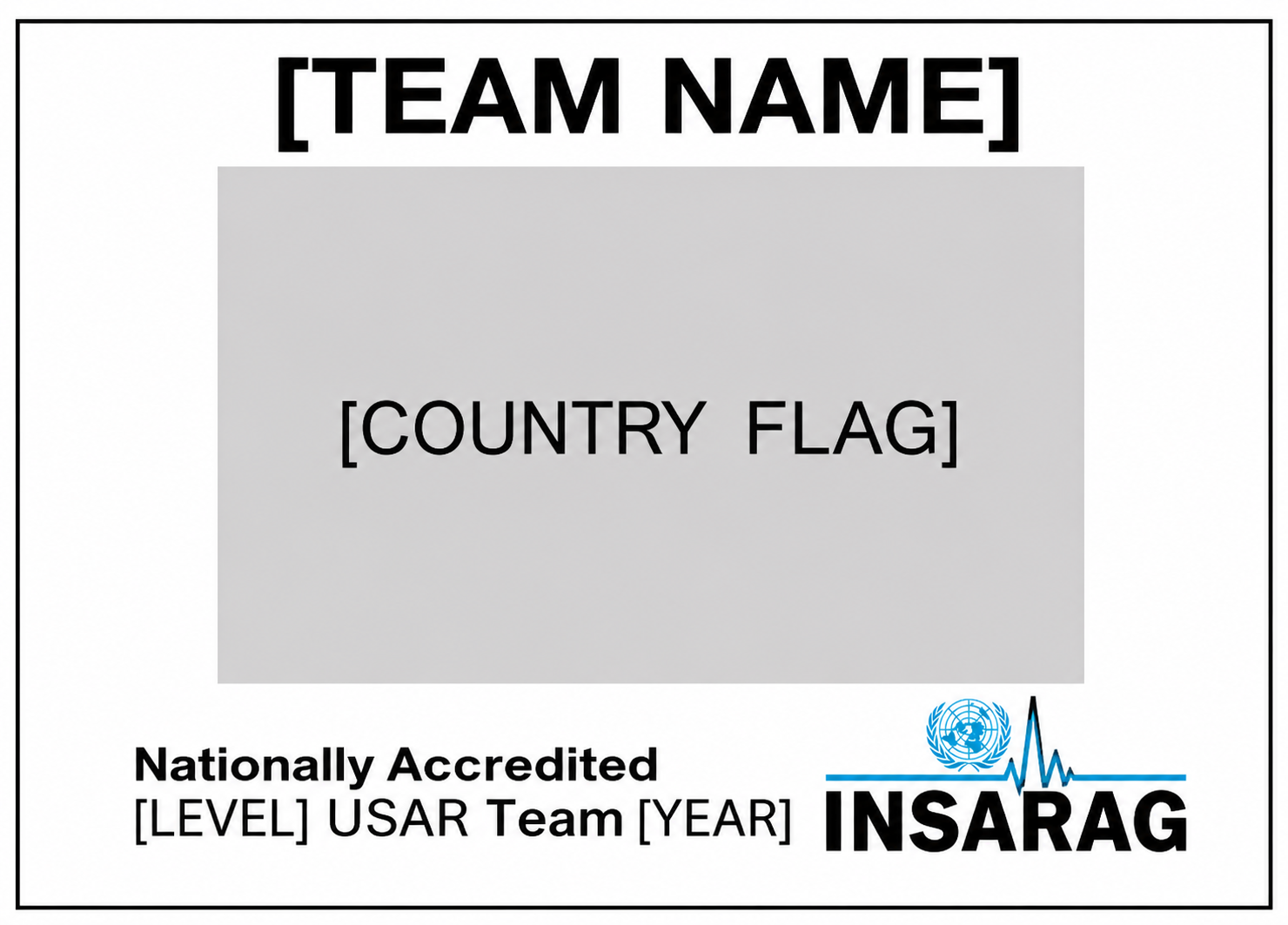
The following conditions should be considered for the nationally accredited USAR teams should they decide on visibility in the field:
Rectangle patch of the size 75 mm x 55 mm.
- Support the implementation of the INSARAG Hyogo Declaration and the UN General Assembly resolution 57/150
- Black wording over a white background and a squared light grey outline
- Flag of the accrediting country is of the size 60 mm x 40 mm
- The patch indicates the following:
- The words “Nationally Accredited”
- Name of the accredited team
- The level and the year of first accreditation
- The INSARAG logo of the size 22 mm x 10 mm
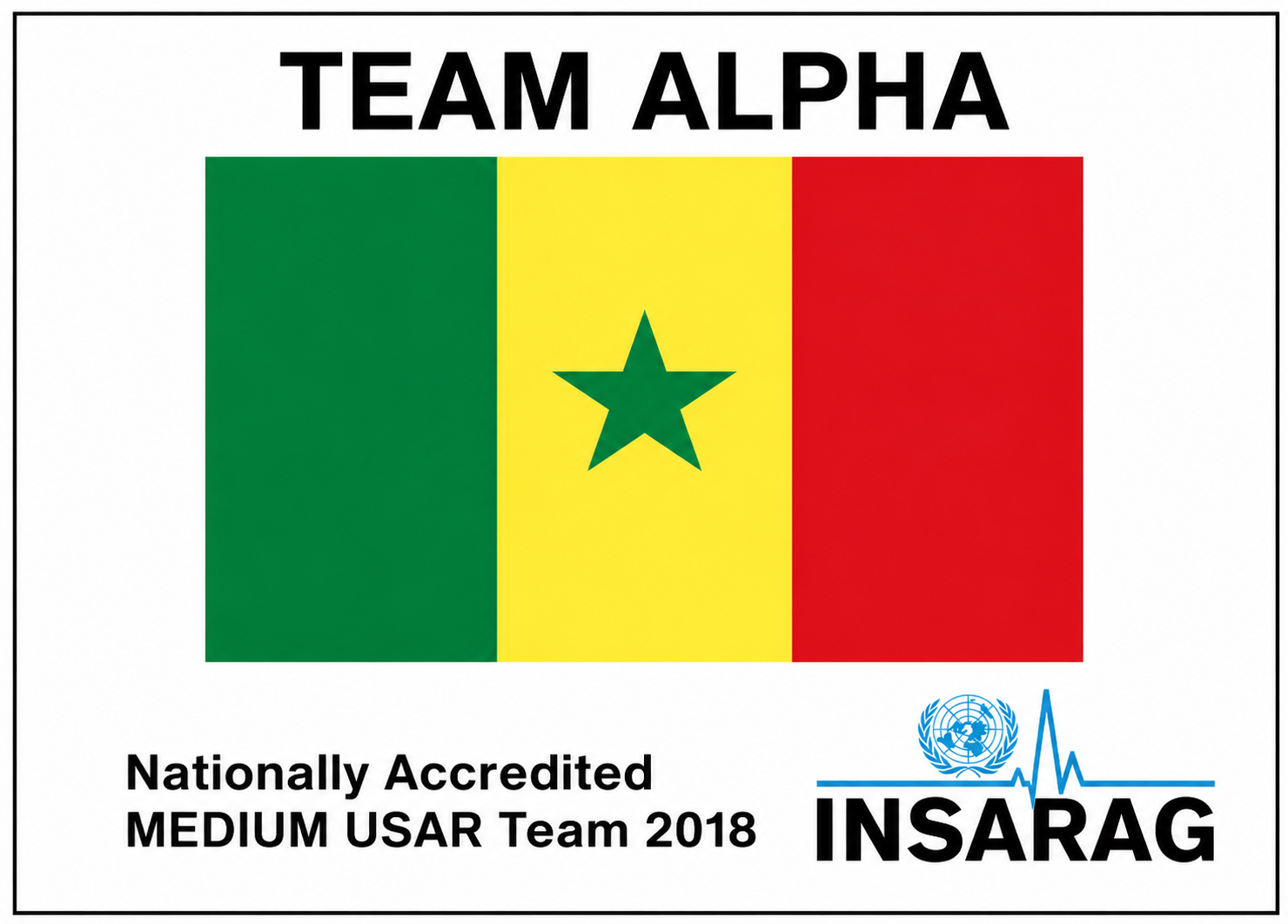
A template for the standardised patch and a generic example are presented as follows:
Template:
Example:
National Responsibilities
Accrediting countries must report to the INSARAG Secretariat on successful nationally accredited teams, the details of which will be updated in the INSARAG USAR Directory.
To sustain USAR national capacity, national mechanisms must undergo regular testing and validation. This can be accomplished through various exercises, including scenario planning, tabletop simulations, and ground deployment exercises. Involving critical stakeholders—such as local communities, private organisations (including NGOs), and governmental entities—is essential for adequate validation. Establishing a comprehensive governmental approach is crucial for validating national emergency mechanisms and enhancing the overall response system. For some, these validation exercises could also be extended to involve the INSARAG regional group and countries of the region.
The INSARAG network conducts annual earthquake response simulation exercises in disaster-prone countries. The objective is to practice the INSARAG methodology with national and international responding organisations. Disaster-prone countries are strongly encouraged to host such exercises to develop their national capacity.