USAR Team Capabilities
Structure and Organisation
The INSARAG methodology suggests that a USAR team be developed in stages, as demonstrated for a technical rescue team. This reduces the potential for missed educational opportunities at the foundational level, expands team members' knowledge base, and assists in team building.
USAR involves locating and rescuing victims trapped or injured in urban environments, most commonly due to the collapse of artificial structures. The cause of the incident can be categorised as accidental, such as natural disasters, or deliberate, such as a terrorist attack. USAR is a specialised field of emergency response that entails rescuing victims from austere environments, typically collapsed structures, using specialised equipment by:
- Searching for the victim using search canines and technical search equipment
- Lifting and moving of heavy objects
- Cutting, breaking and breaching through debris
- Shoring and stabilisation of damaged structures
- Rope rigging systems for transportation above or below ground level
- Providing emergency medical care during the rescue process
USAR is a specific skill set often found within a “multi-disciplined” technical rescue team. However, the team may also have additional capabilities like flood rescue. These capabilities beyond USAR aim to facilitate a thorough and adaptable humanitarian response by enhancing the flexibility of rescue teams in multi-hazard situations and ensuring they remain aligned with the needs of those affected.
The INSARAG methodology strongly suggests that a developing team must build from a strong foundational level rather than from the top down. In this regard, a new USAR Team should not begin development at the Light, Medium, or Heavy level until it can demonstrate proficiency and value at the first responder level.
The entry level in a USAR Team is typically at the First Responder USAR capacity. This progresses from the initial technical rescue team, which employs many of the same structures. The role of a First Responder USAR Team is as follows:
- Reconnaissance and survey of the affected area
- Identify hazards and undertake actions to reduce the level of risk
- Control of public utilities
- Isolation of hazmat and identification of whether it can be safely done
- Surface search and rescue
- Initiating medical care and extrication of victims
- Establishment of Casualty Collection Points
- Assisting international teams in integrating into local emergency management arrangements
The structure of a First Responder USAR Team is designed to maintain a surface rescue capacity at a single worksite. The team can conduct rescues from structures made of wood or light metal components, unreinforced masonry, adobe, raw mud, and bamboo. The search component can perform either a superficial or a physical search. The rescue component of the team will be equipped with hand-operated cutting tools, ropes, and bars for lifting and cribbing materials to stabilise damaged structures.
USAR Team Capacity Levels: Light, Medium and Heavy
National Urban Search and Rescue Teams will consist of specialised teams recognised at three capability levels:
- Light USAR: National, National (Accredited)
- Medium USAR: National, National (Accredited)
- Heavy USAR: National, National (Accredited)
The key distinction between accredited and classified teams is that classified teams can deploy internationally to support other countries. Accredited teams possess the same technical capabilities but operate within the country’s sovereign borders or cross border bilaterally with a neighbouring through an official agreement between both nations.
The team compositions below are suggested compositions and serve as a guidance for capacity building. Other team compositions may be used, depending on national standards and other factors.
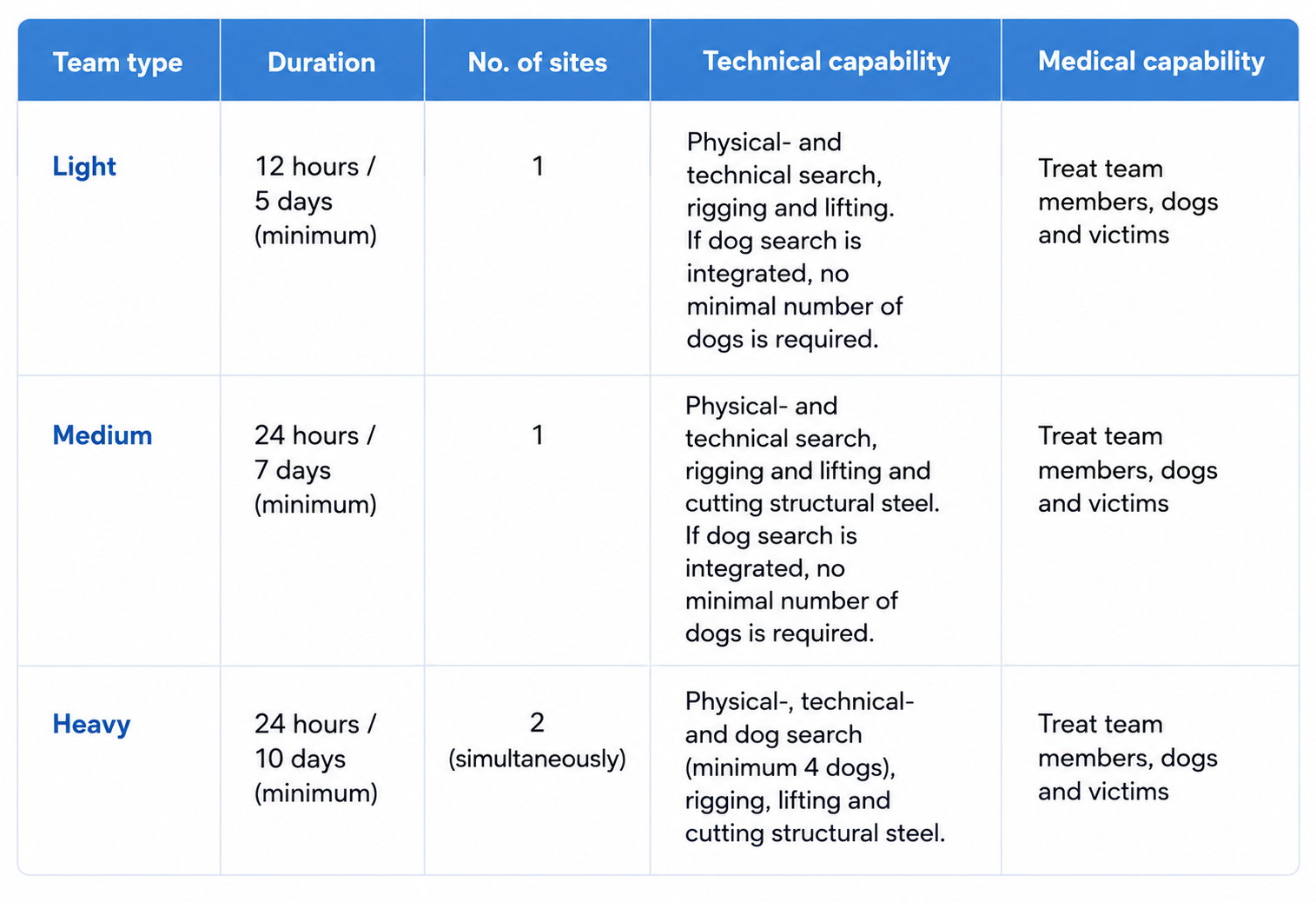
Light USAR Team
A Light USAR Team comprises the five components required by the INSARAG Guidelines: Management, Logistics, Search, Rescue, and Medical. Light USAR Teams can conduct technical search and rescue operations in collapsed or failed structures of wood and/or unreinforced masonry construction, including structures reinforced with steel mesh. The Light USAR Team will also be capable of conducting rigging and lifting operations. Light USAR Teams will possess technical skills similar to those of Medium and Heavy USAR. Light USAR Teams can undertake search and rescue activities up to ASR3 on worksites. A suggested personnel composition for a Light USAR Team is between 17 and 20, with the capability to deploy one member to INSARAG support (RDC/UCC) for the deployment duration. The Team’s logistics component will be able to establish a Base of Operations (BoO), including shelter, sanitation, tool repair, nutrition, and hygiene arrangements.
A Light USAR Team:
- Must be adequately staffed and resourced to allow for 12-hour operations at one site (not necessarily the same site; the sites may change) up to five days
- Is required to have the capability of physical- and technical search
- Dog search is NOT mandatory. If dog search is applied, the number of dogs used, is according to the team’s decision
- Is required to have the technical capability to cut construction material used in light structures
- Must be able to ensure medical care of its team members (including dogs if present) as well as entrapped victims
- Is required to support international coordination (RDC/UCC) with a minimum of one trained staff
- Must be capable conducting USAR operations to ASR level 3 and be integrated into the standard INSARAG coordination and reporting mechanisms
The following table suggests a staffing level enabling a Light USAR Team to conduct 12-hour operations on one worksite.
| USAR Component | Tasks | Suggested Staff Allocation | Suggested Number (17 to 20) |
|---|---|---|---|
| Management | Command | Team Leader | 1 |
Coordination / UCC / RDC / On-Site Operations Coordination Centre (OSOCC) | Deputy Team leader | 1 | |
| Planning / Information / Communications | Planning Officer | 1 | |
| Safety and Security | Safety Officer | 1 | |
| Search & Rescue | Operations | Crew Leader | 1 |
Technical Search / Dog Search / Hazmat Assessment / Breaking and breaching; cutting; shoring; technical rope; Lifting and moving | Search and Rescue team (including dogs if deployed) | 8 (Plus dogs) | |
| Medical | Medical Component Management: Coordination and administration of medical component. Integration with local health infrastructure Care of team (including dogs) and victims encountered | Medical Doctor/ Physician, Paramedic or Nurse | 1 / 1 |
| Logistics | BoO | Logistics Team Manager | 1 |
| BoO | Logistician | 1 | |
| Water supply | |||
| Food supply | |||
| Transport capacity and fuel supply |
Medium USAR Team
A Medium USAR Team comprises the five components required by the INSARAG Guidelines: Management, Logistics, Search, Rescue, and Medical. Medium USAR Teams can conduct technical search and rescue operations in collapsed or failed structures made of heavy timber and/or reinforced masonry construction, including structures reinforced with structural steel. They must also perform rigging and lifting operations. Medium teams are expected to include RDC/UCC components if applicable to the national framework. The primary differences between the two teams are as follows.
A Medium USAR Team:
- Must be adequately staffed and resourced to allow for 24-hour operations at one site (not necessarily the same site; the sites may change) for a minimum of seven days
- Is required to have the capability of physical- and technical search
- Dog search is only mandatory for NAP/IRNAP teams. If dog search is applied, the number of dogs used, is according to the team’s decision
- Is required to have the technical capability to cut and delayer structural building material typically used for construction in multi-storey structures
- Must be able to ensure medical care of its team members (including dogs) as well as entrapped victims
- Is required to support international coordination (RDC/UCC) with a minimum of two trained staff
- Must be capable conducting USAR operations to ASR4 and be integrated into the standard INSARAG coordination and reporting mechanisms
The proposed staffing outlines a level that allows a USAR Team to conduct 24-hour operations on a single worksite for up to seven days.
| USAR Component | Tasks | Suggested Staff Allocation | Suggested Number (total 42) |
|---|---|---|---|
| Management | Command | Team Leader | 1 |
| Coordination | Deputy Team leader | 1 | |
| Planning/Follow Up | Planning Officer | 1 | |
| Liaison/Media/Reporting | Liaison Officer | 1 | |
| Assessment/Analysis | Structural Engineer | 1 | |
| Safety and Security | Safety Officer | 1 | |
| RDC/UCC | Coordination Officer | 2 (if applicable to national) | |
| Search | Technical Search | Technical Search Specialist | 2 |
| Dog Search | Dog Handler and dog | 4 (if applicable) | |
| Hazmat Assessment | Hazmat Specialist | 2 | |
| Rescue | Breaking and breaching; cutting; shoring; technical rope | Rescue Team Manager and Rescue Technicians | 14 (2 teams, 1 Team Leader and 6 Rescuers each) |
| Lifting and Moving | Heavy Rigging Specialist | 2 | |
| Medical | Medical Component Management: Coordination and administration of medical component. Integration with local health infrastructure Care of team (including dogs) and victims encountered | Medical Doctor/ Physician, Paramedic or Nurse | 1 / 3 |
| Logistics | BoO | Logistics Team Manager | 1 |
| Water supply | Transport Specialist | 1 | |
| Food supply | Logistician | 1 | |
| Transport capacity and fuel supply | Base Manager | 2 | |
| Communications | Communications Specialist | 1 |
Heavy USAR Team
A Heavy USAR Team comprises the five components required by the INSARAG Guidelines: management, logistics, search, rescue, and medical. Heavy USAR Teams have the operational capability for complex technical search and rescue operations in collapsed or failed structures that necessitate the ability to cut, break, and breach steel-reinforced concrete, as well as demolish these structures using lifting and rigging techniques, and establish an RDC/UCC component if applicable to the national framework.
A Heavy USAR Team:
- Must be adequately staffed and resourced to allow for 24-hour operations at two separate worksites simultaneously for a minimum of ten days
- Is required to have the capability of dog search (minimum 4 dogs), physical- and technical search
- Must be able to ensure medical care of its team members (including dogs) as well as entrapped patients
- Is required to support international coordination (RDC/UCC) with a minimum of four trained staff
- Is required to have the technical capability to cut and delayer structural building material typically used for construction in multi-storey structures
- Must be capable conducting USAR operations to ASR4 and be integrated into the standard INSARAG coordination and reporting mechanisms
A recommended staffing level in the table down below will allow a Heavy USAR Team to conduct 24-hour operations at two worksites simultaneously for at least ten days.
| USAR Component | Tasks | Suggested Staff Allocation | Suggested Number (total 63) |
|---|---|---|---|
| Management | Command | Team Leader | 1 |
| Coordination | Deputy Team leader | 1 | |
| Planning | Planning Officer | 1 | |
| Liaison/Follow Up | Liaison Officer | 1 | |
| Media/Reporting | Deputy Liaison Officer | 1 | |
| Assessment/Analysis | Structural Engineer | 1 | |
| Safety and Security | Safety Officer | 1 | |
| RDC/UCC | Coordination Officer | 4 (if applicable to national framework) | |
| Search | Technical Search | Technical Search Specialist | 2 |
| Dog Search | Dog Handler | 6 | |
| Hazmat Assessment | Hazmat Specialist | 2 | |
| Rescue | Breaking and breaching; cutting; shoring; technical rope | Rescue Team Manager and Rescue Technicians | 28 (4 teams: 1 Team Leader and 6 Rescuers) |
| Lifting and Moving | Heavy Rigging Specialist | 2 | |
| Medical | Medical Component Management: Coordination and administration of medical component. Integration with local health infrastructure Care of team (including dogs) and victims encountered | Medical Doctor/ Paramedic or Nurse | 2 / 4 |
| Logistics | BoO | Logistics Team Manager | 1 |
| Water supply | Transport Specialist | 1 | |
| Food supply | Logistician | 1 | |
| Transport capacity and fuel supply | Base Manager | 2 | |
| Communications | Communications Specialist | 1 |
Multi-Hazard Response
The "Multi-Hazard Response" approach utilises standard emergency management practices to cover a broader scope of incident types. It enhances flexibility and efficiency by recognising and integrating shared emergency management elements across all hazard types, supplementing these familiar elements with hazard-specific sub-components to address gaps as necessary. It emphasises the utilisation of synergies prevalent across all hazards, thereby improving the capacity of emergency management agencies to tackle unknown hazards.
In the context of USAR Teams, it can be considered a provisional use of the preexisting capabilities within a USAR team outside the traditional technical rescue mandate, where appropriate. These modular components (e.g., Incident Management) can support or lead responses outside the traditional USAR role.
Examples of Multi-Hazard Responses include (but are not limited to):
- Flood response
- Fire response (Wildfire/Forest fire/Bush fire)
- Mountain rescue
- Post Event Debris cleaning
- Water purification (production of drinking water)
- WASH expertise (Water, Sanitation and Hygiene)
- Culture Heritage
- CBRN expertise