Information Package for Unclassified Teams
The main objective of this package is to provide unclassified USAR teams with a clear and concise introduction to the INSARAG system, enabling them to better understand and apply the guidelines during international missions.
This information package aims to:
- Simplification of Guidelines: To provide a simplified version of the INSARAG guidelines, making the essential information more accessible to unclassified teams.
- Rapid Training: Serve as a rapid training tool, allowing teams to quickly familiarize themselves with the basics of the INSARAG system even in emergency situations.
- Improved of coordination: Facilitate communication and coordination between unclassified and classified teams, as well as with command and coordination structures (LEMA, UCC, SCC).
- Reduced workload: Lighten the workload of command and coordination teams by reducing the time needed to train unclassified teams on site.
Core concepts
INSARAG
INSARAG was created in 1990 following the initiatives of the specialised international USAR Teams who operated together in the Mexican earthquake of 1985 and Armenian earthquake of 1988. INSARAG is an intergovernmental humanitarian network of disaster managers, government officials, non-governmental organisations (NGOs) and USAR practitioners operating under the umbrella of the UN. 57 classified USAR teams.
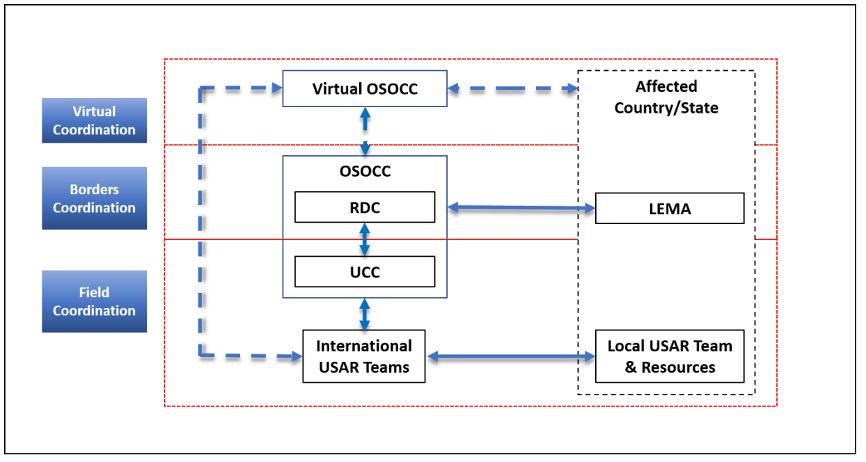
RDC
The RDC serves as the central intake hub for international relief traffic and is often the first
OSOCC component established in the affected country. The main objectives of an RDC are the following:
- Support authorities at the point of entry (airport, seaport, etc.) in managing arrival of international teams.
- Record and help coordinate the response of international teams and link them up with the coordination structure.
- Brief arriving teams on the situation and practical information that they need to know for immediate onward deployment to the affected areas, e.g., logistics, etc.
UCC
The objective of the USAR Coordination cell is to coordinate the deployment and most efficient
operation of all the USAR teams (classified or non-classified) involved in the total relief operation.
The UCC does this as part of the OSOCC and with the approval of and coordination with the LEMA.
OSOCC
The On-Site Operations Coordination Centre (OSOCC) provides a platform to centralise the coordination
of international response activities in the immediate aftermath of a sudden-onset emergency or a
rapid deterioration in a complex emergency. It is concurrently both a methodology and a physical
location for on-site emergency response coordination, designed to work in support of the Government
of the affected country and as a tool for OCHA to carry out its mandate of coordination and information
management in emergency response, particularly at the field level.
LEMA
The Local Emergency Management Authority is the local/national body that has the overall responsibility
for the disaster management in a region and/or a country.
ASR
USAR operations are divided into the five levels listed in the table below. These levels are defined
as sequential activities, but, in reality, teams may receive assignments in any order. Especially
in large scale operations where LEMA identifies worksites before teams arrive. Or when new areas
are being opened throughout the response. Hence different levels of work are being carried out in
different areas of the incident at the same moment.
The five levels are identified as:
- Level 1: Wide Area Assessment
- Level 2: Worksite Triage Assessment
- Level 3: Rapid Search and Rescue
- Level 4: Full Search and Rescue
- Level 5: Total Coverage Search and Recovery (not for USAR)
Essential Information by RDC
- Team ID code of the USAR non-classified
- Sector and worksite ID code
- ASR level
- Documents (maps, factsheet, demobilization form, worksite triage form, victim extrication form). A condensed version of the INSARAG guidelines, highlighting the critical procedures to be followed.
- UCC contact
- Needs (accommodation, equipment…)
USAR Methodology
Key principles of the USAR methodology under INSARAG:
- Assessment
- Marking system
- Exchanges of information with UCC (UCC email address and phone)
Tools and Technologies
A quick guide to explain INSARAG technological tools and forms:
Intervention Checklist
A checklist to help teams ensure that they meet minimum performance standards (GPS coordinates, Victims alive or dead, needs etc.).
Contents:
- Key Abbreviations (INSARAG, USAR, UCC, RDC, SCC, BoO, ASR, ICMS, OSOCC, UNDAC, VO, LEMA)
- Categories of INSARAG Classified USAR Teams
- Team ID Code
- Sectorisation
- Sector ID Code
- Worksite ID Code
- ASR Levels
- Triaging Tree (Figure and description)
- Worksite Marking (Figure and description)
- Victim Marking (Figure and description)
- INSARAG Signalling
- Core Coordination Structure and main information flow (Figure and description)
- Key INSARAG Forms (USAR Team Fact Sheet Form & Demob Form, Worksite Triage Form, Worksite Report Form, Victim Extrication Form)
- Links for related manuals (UC Manual, ICMS Team Guide, VO for USAR teams)