Phases
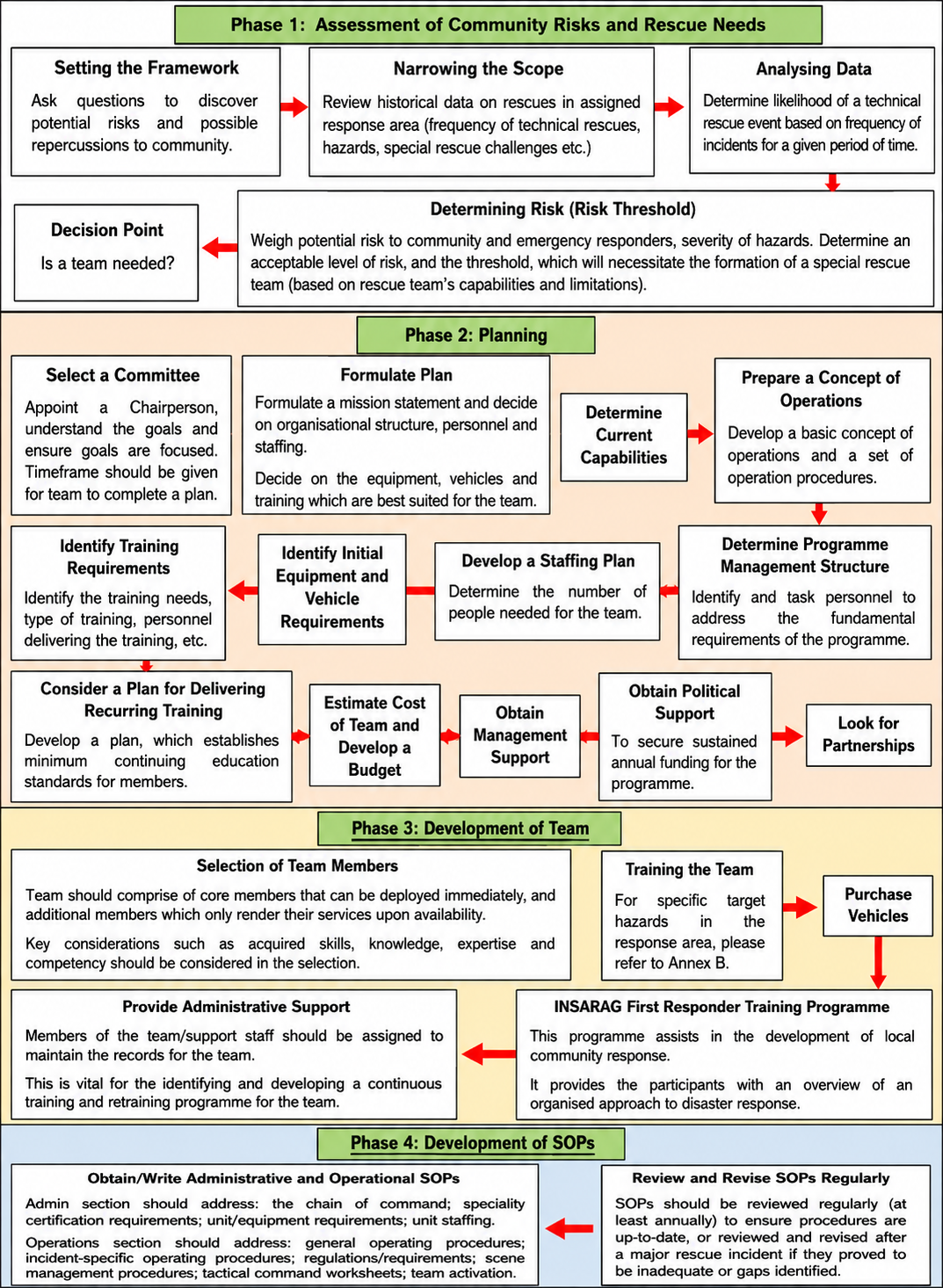
Phase 1: Assessment of Community Risks and Rescue Needs
Conduct a Risk Assessment
Before establishing a technical rescue or USAR team, the sponsoring organisation must conduct a comprehensive risk assessment to identify local hazards and evaluate potential rescue needs. This process supports evidence-based decision-making and provides justification to political and financial authorities.
Key questions include:
- What are the most significant natural or human-made hazards in the community?
- What would be the impact if the worst-case scenario occurred today?
- How would the community respond if no local capacity existed?
- What would be the human, environmental, and reputational consequences of non-preparedness?
The assessment should:
- Review historical incident data and emerging risks (e.g. new construction, infrastructure projects, industrial growth)
- Identify target hazards such as rivers, cliffs, tunnels, industrial facilities, and high-rise buildings
- Consult with national statistics offices, local authorities, and safety regulators to collect relevant data
- Develop a list of specific high-risk locations requiring specialist rescue capability
- Evaluate the frequency and nature of past technical rescues in the response area, and anticipate potential new hazards based on planned or ongoing developments
All communities, regardless of size, face potential risks (e.g. transportation accidents, construction collapses, or industrial incidents) that may require technical rescue expertise. The types of industries in the community can guide officials in prioritizing technical rescue training based on the most likely incidents associated with those industries.
Analyse Risk Data
Analyse collected data to project the likelihood and potential severity of technical rescue incidents.
Typical community hazards may include:
- Confined spaces/ restricted access (tunnels, tanks, sewers)
- Waterways and flood-prone areas (swift or calm water rescue)
- Industrial and agricultural sites (machinery entrapment, hazardous materials)
- Cliffs, ravines, or mountains (rope and high-angle rescue)
- New or aging structures (collapse or trench rescue)
- Transportation networks (road, rail, and air incidents)
Establish a Risk Threshold
Communities must define an acceptable level of risk and determine when that threshold warrants forming a dedicated rescue team. This requires balancing the risk to the public against the risk to responders. Rescuers face varying hazards depending on the discipline for example, asphyxiation (confined space), drowning (water), falls (rope), or secondary collapses (structural).
Trained rescuers operate within defined capacity limits; untrained spontaneous responders do not. Communities must therefore ensure that technical rescues are undertaken only by properly trained and equipped personnel.
The outcome of the risk analysis should define:
- Whether a technical rescue or USAR team is justified
- Which disciplines are required (e.g. rope, trench, structural collapse, confined space, water)
- The appropriate level of capability (single- or multi-discipline)
Initial development should prioritise one core discipline, establishing proficiency before expanding into additional areas.
Phase 2: Planning
Establish a Planning Committee
Form a technical rescue development committee comprising competent planners and prospective team leaders. The committee should include members with relevant operational experience and at least one senior manager to provide direction and ensure alignment with organisational goals.
The committee’s tasks include defining:
- The mission statement and objectives
- The organisational structure, including command hierarchy, administrative and decision-making processes
- Personnel requirements and selection criteria
- Equipment, vehicles, and training requirements
- A clear implementation timeline
- Initial and ongoing proficiency required training
Once the team type is determined, the sponsoring organisation should create a plan covering personnel, equipment, and training. This plan should include leadership structure, record-keeping, equipment inventory, program oversight, and political support requirements
Determine Existing Capabilities
Identify existing assets including equipment, vehicles, trained personnel, and facilities that can support team formation. Leveraging existing capacity reduces start-up costs and accelerates readiness.
Develop a Concept of Operations (CONOPS)
Create a Concept of Operations to define how the team will operate, its response triggers, resource deployment, and integration with existing emergency management structures.
This document demonstrates planning maturity and provides a framework for developing detailed Standard Operating Procedures (SOPs).
Establish a Programme Management Structure
Assign key management roles, including:
- Programme Officer – overall coordination, administration, and reporting.
- Training Officer – training development, delivery, and certification tracking.
- Equipment Officer – equipment procurement, maintenance, and cache management.
- Administrative Support/Scribe – documentation, data management, and logistics tracking.
A defined management structure ensures accountability and continuity through all development phases.
Develop a Staffing Plan
Determine team size based on the selected disciplines and anticipated operational demands. Ensure sufficient personnel for all command and tactical roles, incorporating redundancy as per INSARAG's 2:1 staffing ratio (two qualified members for each deployable position).
Trench, structural collapse, and high-angle operations are staffing intensive and must be resourced accordingly. Staffing plans should also specify personnel per rescue unit or vehicle.
Identify Equipment and Vehicle Requirements
Develop a discipline-specific equipment list, then consolidate into a single procurement plan. Where resources already exist, centralise or catalogue them for rapid deployment. Prioritise purchases that enhance personnel safety before those that expand capability. Plan for redundancy as critical equipment must have backup. Identify suitable vehicles or trailers for personnel and cache transport; conversion of existing assets or donated vehicles may be viable options.
Identify Training Requirements
Define required training for all rescue disciplines, ensuring compliance with national or occupational safety standards. Identify training needs based on the team’s focus and any local or state regulations. Determine training delivery methods, providers, schedules, and establish a plan for developing an internal cadre of instructors to support ongoing training and capacity building.
Plan for Recurring Training
Develop a sustainment training plan that maintains member competency through periodic exercises and refresher courses. Where national standards exist, align with established continuing education requirements. Account for associated costs in annual budgets.
Estimate Costs and Develop a Budget
Prepare a detailed costed implementation plan covering:
- Personnel hours and training
- Consumables and PPE
- Equipment and vehicles.
- Communications and medical supplies
- Facility use, insurance, and logistics
- Travel, vaccinations, and post-deployment care
Budgeting must include the design of training areas or access to local target hazards for realistic training. Conduct market research with suppliers to validate pricing and ensure comparability.
Differentiate between essential start-up costs and future capability expansion to facilitate phased implementation.
Obtain Management Support
Gain formal endorsement from organisational leadership by clearly articulating the operational, reputational, and community benefits of forming a team. Prepare supporting evidence, examples from other jurisdictions, and visual materials (e.g. presentations, case studies) to communicate the value proposition effectively.
Obtain Political Support
Political endorsement is essential for sustained funding. Anticipate and prepare responses to common questions regarding cost, frequency of use, and inter-jurisdictional cooperation. Provide evidence of hazard exposure, incident history, and potential liabilities of non-preparedness. Engage with elected officials early to build advocacy and ownership. Below is a list of tips that may help the sponsoring organisation win political support:
- Be sure to have support from the sponsoring organisation before going to the elected officials.
- Discuss the concept of a team with relevant elected officials.
- Prepare a list of hazards in the response area and note the dangers and risks associated with each. Give this to the elected officials.
- Create a video or slide presentation that will demonstrate the hazards that exist in the area. Be sure to note the risks presented by each to both citizens and rescuers.
- Discuss what will be the acceptable risk thresholds.
- The sponsoring organisation may gather action pictures of rescue teams already formed to demonstrate team capabilities.
- Have charts prepared that demonstrate the need for a team and show the number of rescue incidents the sponsoring organisation has ran in the past and expect to run in the future.
- Have charts prepared that outline a plan for developing the team.
- Be prepared to discuss regulations, such as those for confined spaces, which may require the sponsoring organisation to train personnel to a certain rescue level to make certain rescues. This alone may justify the team.
- Become familiar with other rescue programmes around the region or country that will serve as examples.
Develop Partnerships
Establish partnerships with industry, government, and regional organisations to share resources, facilities, and funding. Local industries may benefit from cooperative confined space or hazardous environment rescue agreements.
The INSARAG Regional Group provides a platform for Member States and teams to explore technical and financial collaboration, including donor engagement at the regional level.
Phase 3: Development of the Team
Selection of Team Members
Team member selection must align with the operational requirements identified during the planning phase. Core members should be deployable immediately, while additional personnel (volunteers or reserve members) can provide surge capacity when available.
Key selection criteria include:
- Proven technical and operational competence.
- Relevant professional or trade experience (e.g. construction, rope access, EMS, engineering).
- Commitment to ongoing training and operational readiness.
- Medical fitness and availability for deployment.
A structured recruitment process should include:
- Soliciting expressions of interest.
- Completion of a short skills and motivation questionnaire.
- Formal interviews and reference checks.
Expectations including training frequency, deployment readiness, and time commitments must be clearly defined before appointment. Priority should be given to candidates with medical training or multidisciplinary experience, as technical rescue operations often require an integrated medical and rescue capability.
Team Training
Teams must complete an initial foundational training programme covering:
- Equipment familiarisation and maintenance.
- Discipline-specific technical rescue skills.
- Safety protocols and hazard recognition.
- Command, control, and communication procedures.
- Medical and casualty management skills.
Training should include both theoretical and technical instruction as well as practical scenario-based exercises. The INSARAG stair-step methodology should be followed, beginning with basic principles, then progressing to complex, multi-discipline exercises.
Whenever possible, teams should train jointly across disciplines to build interoperability and teamwork. Realistic training environments such as construction sites, disused buildings, or trenches should be used through cooperation with local contractors or agencies, following a full risk assessment.
Ongoing refresher training and certification maintenance are essential for sustained readiness.
Procurement of Equipment and Uniforms
Procurement must align with the team’s mission profile and previously defined equipment plan. Begin with essential safety and rescue equipment, expanding capability as experience and funding allow. Ensure all equipment meets recognised international standards (e.g. EN, NFPA, or ISO). Uniforms should be durable, identifiable, and compliant with occupational safety standards.
Vehicles and Storage
Vehicle selection should consider the type of operations, environment, and payload requirements. Detailed vehicle layout plans must be prepared to ensure efficient storage and accessibility of equipment. Allow for at least 30% growth capacity for future equipment additions.
Secure, climate-appropriate storage must be provided for vehicles and cache. Vehicle design should include safe mounting, proper weight distribution, and appropriate towing capacity (if trailers are used).
Teams should also assess insurance requirements for each jurisdiction, region, state or county in which they may operate, ensuring they carry appropriate coverage for the operating area.
Administrative Support and Record Management
Effective administration underpins operational readiness. Dedicated personnel should be assigned to maintain the following records:
- Team roster and personnel profiles
- Medical and immunisation records
- Licences, certifications, and specialist registrations
- Training attendance and qualification records
- Equipment inventories, inspection, and maintenance logs
- Deployment plans, activation procedures, and after-action reports
- Budget, expenditure tracking and asset management records
Administrative staff must also manage training schedules, monitor equipment calibration, and maintain deployment readiness documentation. These records support accountability, audit compliance, and future capability development.
INSARAG First Responder Training Programme
To support local capacity development, INSARAG provides the First Responder Training Programme, adaptable to national or local contexts. This programme is designed for community-based responders and emergency services personnel who may be first to arrive at a sudden-onset disaster.
Programme components:
- INSARAG First Responder Course.
- INSARAG First Responder Training of Trainers Course.
- Participant training materials and instructor guides.
Learning objectives:
- Recognise generic hazards and risks in a collapse environment.
- Conduct rapid area assessments.
- Perform surface search, rescue, and basic life-saving actions.
- Coordinate with organised emergency services.
- Understand national, regional, and international USAR systems.
- Manage spontaneous volunteers on-site.
Further details regarding the programme are available at www.insarag.org or from the INSARAG Secretariat.
Phase 4: Development of Standard Operating Procedures (SOPs)
Establish Administrative and Operational SOPs
SOPs are essential for safe, coordinated, and efficient technical rescue operations. They should align with the approved CONOPS and integrate with existing organisational procedures.
SOPs define:
- Command structure and roles.
- Equipment use and maintenance.
- Operational techniques and safety standards.
- Training, certification, and personnel management.
- Activation, deployment, and demobilisation procedures.
SOPs should be consolidated into a single manual, divided into Administrative SOPs and Operational SOPs:
-
Administrative SOPs
- Address governance and management, including:
- Chain of command and reporting lines.
- Certification and training requirements by discipline.
- Equipment cache management, inspection schedules, and maintenance cycles.
- Minimum staffing levels and role-specific qualifications.
- Address governance and management, including:
-
Operational SOPs
- Define tactical operations, including:
- Types of incidents covered (collapse, rope, trench, confined space, water).
- Dispatch and response procedures.
- Scene management and command structure (aligned with Incident Command System principles).
- Technical operating procedures and discipline-specific tactics.
- Applicable local or national regulatory requirements.
- Activation, deployment and demobilisation processes.
- Define tactical operations, including:
Operational SOPs should include tactical worksheets or command checklists for each discipline to assist on-scene decision-making.
SOP Review and Continuous Improvement
SOPs must be reviewed at least annually and following any major incident, exercise, or identified gaps. Updates should reflect lessons learned, new equipment, or revised safety standards. Regular review ensures the team maintains compliance with INSARAG Guidelines, national legislation, and international best practice.